Successful Odoo ERP Implementation: A Complete Guide for SMB Owners and Founders (2026)
 Siddharth JambukiyaOdoo Techno-Functional Consultant




As an owner or founder, you do not need to configure Odoo, but you do need to make the calls that decide whether it succeeds. This Odoo ERP implementation guide walks those decisions in simple language.
For the build itself, our Odoo implementation services cover scoping to go-live, and the sections below help you steer the project even if someone else does the work.
What Odoo ERP implementation actually means for your business
Odoo ERP implementation is the process of configuring, customizing, and rolling out Odoo so it runs your real operations, from sales and inventory to accounting. It is a business project with software in it, not a software install.
For an owner, that means mapping how your business actually works, deciding what to change, migrating your data, training your team, and going live without stopping the business. The software is the easy part; the process and people are where projects succeed or fail.
This guide focuses on the decisions you own. For the detailed technical steps, see our 10 steps to a successful Odoo ERP implementation.
Odoo implementation strategies: which rollout fits your business?
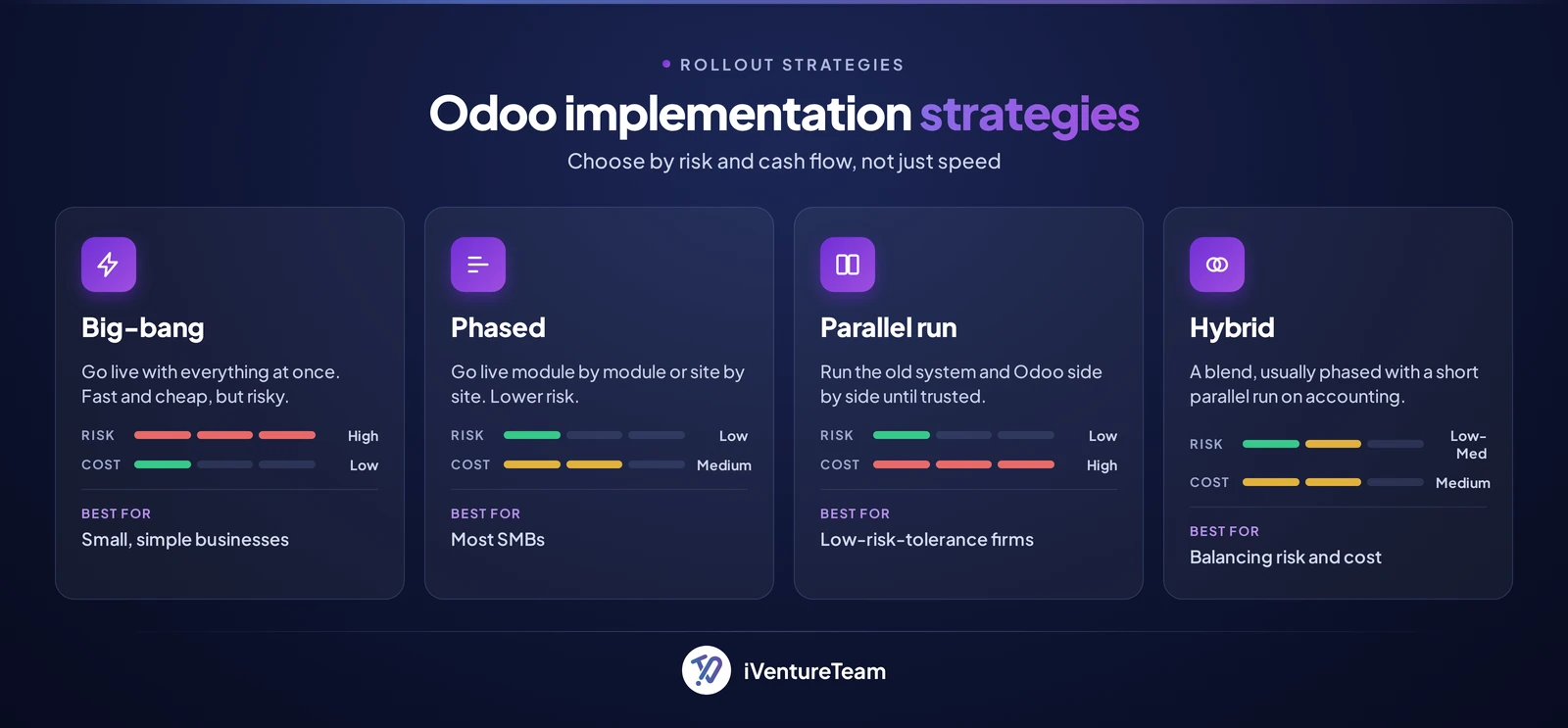
There are four main Odoo implementation strategies: big-bang, phased, parallel run, and hybrid, and the right one depends on your risk tolerance and cash flow. This is the first big decision an owner makes.
Big-bang goes live with everything at once. It is faster and cheaper, but if something breaks, it breaks everywhere, so it suits smaller, simpler businesses.
Phased rollout goes live module by module or site by site, which lowers risk and lets your team adjust. It is the safest choice for most SMBs.
Parallel run keeps the old system and Odoo running side by side until you trust Odoo. It is the safest but the most expensive and tiring, because staff do everything twice. Hybrid blends these, often a phased rollout with a short parallel run on accounting.
Choose by risk, not by speed. If a bad week would seriously hurt the business, favor phased or parallel; if you are small and nimble, big-bang can work.
The Odoo implementation lifecycle at a glance
Every Odoo implementation moves through the same phases, whatever the strategy: discovery, design, build, data migration, testing, training, go-live, and support. Knowing them helps you spot where a project is drifting.
Phase | What happens | What the owner watches |
|---|---|---|
Discovery | Map processes, set goals and scope | Scope is written down and agreed |
Design | Configure Odoo, plan customizations | Customizations are justified, not nice-to-have |
Build | Set up modules, build custom code | Progress against the agreed scope |
Data migration | Clean and move your data | Data is accurate, not just moved |
Testing | Validate real scenarios | Your team tests, not just the vendor |
Training | Prepare the team to use Odoo | People are ready, not just informed |
Go-live | Switch to Odoo | A rollback plan exists |
Support | Fix, adopt, improve | Adoption and open issues |
These phases mirror the approach in Odoo's official documentation, and our Odoo implementation methodology breaks each one down.
How long does an Odoo implementation take, and what does it cost?
A focused SMB Odoo implementation typically takes 4 to 14 weeks and costs roughly $5,000 to $45,000, with Odoo licenses billed separately. The variables are scope, customization, data, and the number of users.
Here are our published ranges by project size, so you can see where you are likely to land:
Project size | Users | Timeline | Implementation cost |
|---|---|---|---|
Starter | 5 to 25 | 4 to 8 weeks | $5k to $15k |
Growth | 25 to 100 | 8 to 14 weeks | $15k to $45k |
Enterprise | 100+ | 12 to 24 weeks | $45k to $250k+ |
These are implementation costs only. Odoo Enterprise licenses are billed separately at about $31 per user per month, and optional ongoing support runs roughly $1k to $8k per month.
The final investment depends on your business requirements, number of users, customizations, and support needs, which are key factors when evaluating Odoo pricing.
A single-entity rollout on standard modules lands at the Starter end, while a multi-entity or heavily customized project reaches Growth or Enterprise. The fastest projects have a tight scope and a decisive owner.
On budget, plan for implementation and support to outweigh the license cost, and treat an unusually low quote with suspicion. For a full breakdown and a cost calculator, see our Odoo implementation cost guide.
Those license figures hinge on one more choice: Community or Enterprise.
Odoo Community vs Enterprise, and where to start
Odoo comes in two editions: Community and Enterprise. Community is free and open source, while Enterprise is a paid edition that adds advanced features such as accounting, Odoo Studio, mobile apps, and official support. For most SMBs looking for a complete ERP solution, Enterprise delivers strong value, while Community is better suited for simpler requirements or budget-conscious businesses.
Community covers core sales, inventory, and basic invoicing, and it is a fair start if your needs are light and you have technical help. Enterprise adds full double-entry accounting, bank sync, Studio customization, and vendor support, which most growing businesses end up needing.
On licensing, Odoo bills Enterprise separately at about $31 per user per month, while Community carries no license fee. Weigh that against the features and support you actually need, not the sticker price alone.
Where you start matters as much as the edition. Begin with the modules tied to your biggest pain, usually accounting, sales, and inventory, prove value there, then add the rest in later phases.
With your edition and starting scope set, the next decision is who builds it.
How to choose your Odoo implementation partner
Choose an Odoo implementation partner on industry references, a clear written scope, and a named team, not on the lowest price. The partner decision is the one most correlated with success.
Ask for references in your industry and talk to them about deadlines and what broke. Insist on a written scope and a fixed or clearly staged price, so you are not exposed to open-ended billing. A good partner pushes back on unnecessary customization rather than selling it.
If you are weighing firms, our how to choose an Odoo development company guide gives you a checklist, and you can also hire Odoo developers directly.
The partner is only half the people equation; your own team is the other half.
What you and your team need to bring
A successful Odoo implementation needs four roles on your side: an executive sponsor, process owners, a data owner, and a few hands-on testers. The Odoo partner builds the system; these people make sure it fits and gets adopted.
The executive sponsor is usually you, the owner or founder. You set priorities, approve or reject scope changes, and unblock decisions quickly. Projects stall the moment this seat sits empty.
Process owners are your leads for sales, inventory, or accounting. They explain how the work really happens and confirm the configured process matches reality, not the org chart.
A data owner cleans and approves the records you migrate. Someone must own product lists, customers, and opening balances, or dirty data quietly becomes your Odoo's problem.
Finally, name a few testers and champions who run real scenarios before go-live and help teammates after. They turn a technically live system into one people actually use.
Leave any of these seats empty and you invite the exact failures the next section covers.
Why Odoo implementations fail (and how to protect yourself)
Odoo implementations rarely fail on the software; they fail on scope creep, poor data, weak training, no executive sponsor, and picking the cheapest partner. As the owner, you can prevent every one of these.
Scope creep is the biggest killer: every extra customization adds time, cost, and upgrade risk, so approve changes deliberately.
Dirty data is the second: if you migrate messy records, you get a messy Odoo, so clean before you move.
Weak training and change management come next, because a system nobody adopts is a failed project regardless of how well it was built. And an absent owner is fatal, since the calls on scope, priorities, and go-live need someone with authority.
The pattern is clear: the risks are managerial, not technical. That is exactly why an owner who stays engaged is the single biggest success factor.
What a successful Odoo implementation looks like
A successful Odoo implementation has an engaged owner, a tight scope, clean data, a trained team, and a phased path to value, with the business running better within weeks of go-live. Success is visible, not vague.
You should see faster processes, fewer manual errors, and real-time numbers you trust, not just a system that is technically live. The best implementations deliver a quick early win, then build on it, rather than trying to boil the ocean on day one.
If you can point to one process that is measurably better a month after go-live, the project is on track. If not, revisit scope and adoption before adding anything new.
After go-live: adoption, support, and continuous improvement
The project is not done at go-live; the value comes from adoption, support, and steady improvement over the following months. This is where many owners lose momentum, and where the return actually lands.
Keep a support line open for the first weeks, watch which features people avoid, and fix the friction. Then improve in small, deliberate steps, adding the next module or automation once the last one has stuck.
Treat Odoo as a platform you grow into, not a one-time install. The businesses that get the most from it keep refining it long after go-live.
How iVentureTeam helps SMBs implement Odoo
iVentureTeam scopes, implements, and supports Odoo for SMBs, so owners get a rollout that fits their risk, budget, and timeline. We do the build; you keep control of the decisions that matter.
Our expert Odoo developer team maps your processes, recommends the right rollout, migrates your data cleanly, and trains your people, with a written scope and clear milestones. Moving off Tally, QuickBooks, or spreadsheets, we cover the whole journey, and you can see the outcomes in our Odoo client case studies.
That combination of a disciplined process and senior engineers is what turns an Odoo project from a risk into a return.
Odoo implementation in practice: a phased 8-week rollout that ended stock guesswork
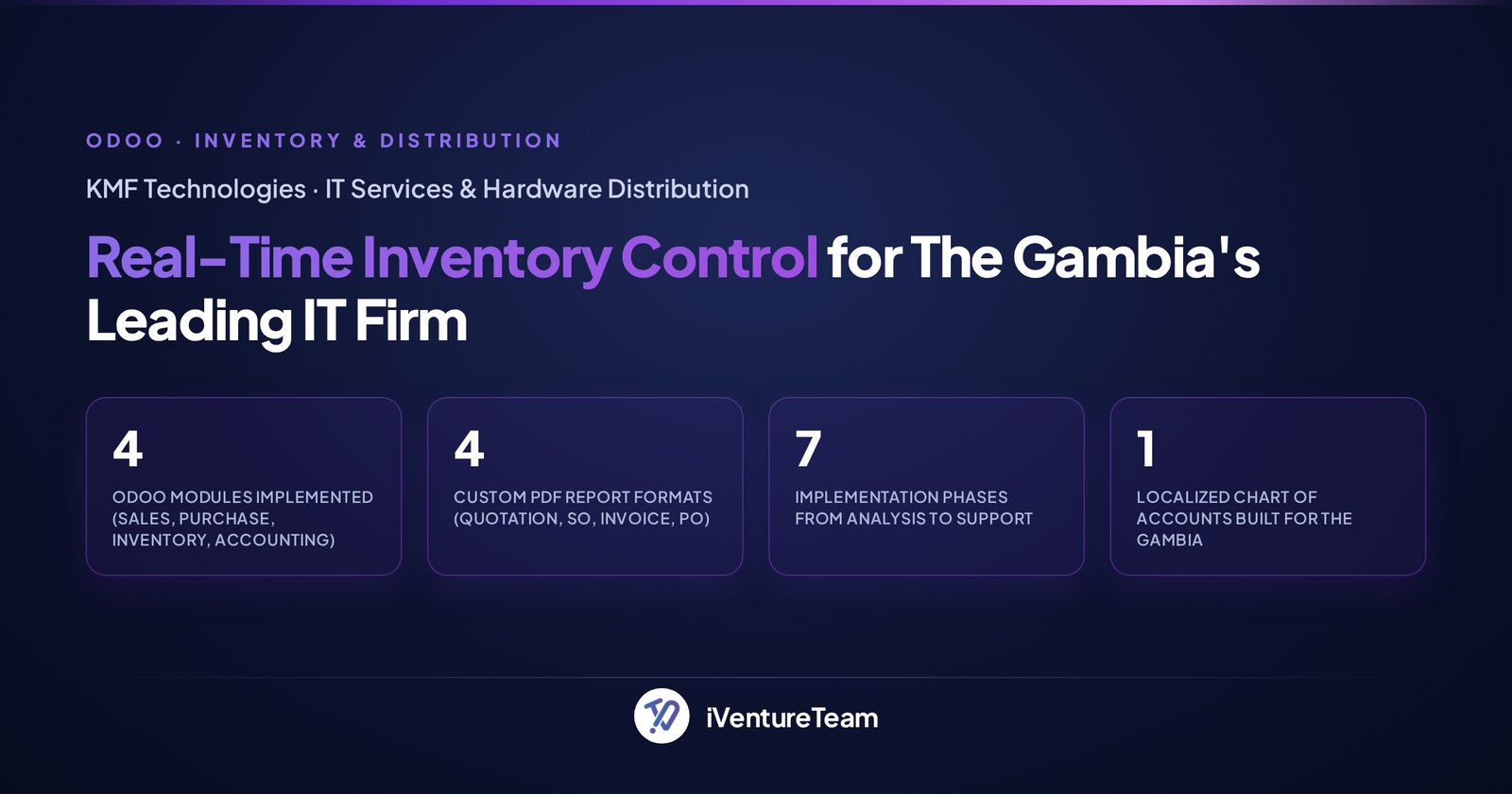
KMF Technologies, a leading IT & hardware distributor in The Gambia, replaced manual stock tracking with Odoo in an 8-week phased rollout, moving from guessed inventory to real-time numbers its team trusts. It shows how a disciplined, phased approach, not the software alone, delivers the result.
KMF ran sales, purchase, and store on hand-kept lists with no shared visibility, so staff checked stock department by department. iVentureTeam ran a structured seven-phase implementation, from requirements to post-go-live support, across Sales, Purchase, Inventory, and Accounting.
Clean data migration, a localized chart of accounts, staff training, and a phased go-live took KMF live without disruption. As their director put it, they went from guessing stock levels to trusting them, with purchasing finally running on real numbers.
The bottom line on a successful Odoo implementation
A successful Odoo ERP implementation is won on owner decisions: the right rollout strategy, an honest budget, a proven partner, tight scope, and real change management. Get those right and Odoo delivers; get them wrong and the best software still fails.
You do not need to become technical. You need to pick the strategy, protect the scope, and stay engaged through go-live. Do that, and Odoo becomes the system your business runs on.
Ready to plan your Odoo implementation?
You do not have to figure out the strategy, timeline, and budget alone. In one free 30-minute consultation, a senior Odoo consultant will assess your business, recommend the right rollout, and outline a realistic plan.
Book your free consultation, call +91-93270-18076, or email business@iventureteam.com.
Frequently Asked Questions about Odoo ERP Implementation
How long does an Odoo ERP implementation take?
+
A focused single-entity Odoo implementation on standard modules can go live in 4 to 8 weeks, while multi-entity or heavily customized projects take 3 to 6 months. The biggest factor is scope discipline. iVentureTeam recently took a Gambian IT distributor live in an 8-week phased rollout.
How much does an Odoo implementation cost?
+
Most SMB Odoo implementations run $5,000 to $45,000 over 4 to 14 weeks, depending on scope, customization, users, and integrations. Odoo licenses are billed separately at about $31 per user per month. Treat unusually low quotes with caution.
Should I choose Odoo Community or Enterprise?
+
Community is free and open source, covering core sales, inventory, and basic invoicing. Enterprise is paid, about $31 per user per month, and adds full accounting, Studio, mobile apps, and support. Most growing SMBs pick Enterprise; Community suits simpler, budget-tight setups.
What is the best Odoo implementation strategy, big-bang or phased?
+
For most SMBs, a phased rollout is safest because it limits risk and lets the team adjust. Big-bang is faster and cheaper but riskier, and a parallel run is safest but costliest. Choose based on how much a bad week would hurt the business.
Why do Odoo implementations fail?
+
They rarely fail on the software. The common causes are scope creep, poor data quality, weak training and change management, no executive sponsor, and choosing the cheapest partner. Each of these is a management issue an engaged owner can prevent.
Do I need a partner, or can I implement Odoo myself?
+
A very small business on standard modules can self-implement, but most SMBs benefit from a partner for scoping, data migration, customization, and training. The partner reduces risk and time; just choose on references and a clear scope, not price.
What roles do I need on my team for an Odoo implementation?
+
Name an executive sponsor (usually the owner), process owners for each area like sales and accounting, a data owner to clean and approve migrated records, and a few testers. The partner builds Odoo, but these people make sure it fits your business and gets adopted.
What does an owner need to do during an Odoo implementation?
+
Set the goals and scope, choose the rollout strategy and partner, approve or reject customizations, make sure your team tests and trains, and sign off on go-live. You do not configure Odoo, but you make the decisions that decide whether it succeeds.
Ready to put this into action?
Talk to iVentureTeam about Odoo, AI automation, or custom development — get a free, no-obligation consultation.
Continue reading

Odoo API and Third-Party Integration: A Practical Guide (2026)
Read article
Odoo Online vs Odoo.sh vs On-Premise: How to Choose Your Odoo Hosting (2026)
Read article