Odoo ERP Implementation Methodology: The 8-Phase Framework for a Successful Go-Live
 Siddharth JambukiyaOdoo Techno-Functional Consultant




A growing business does not fail at Odoo because the software fell short. It fails because the implementation has no method.
ERP projects break at a startling rate. Panorama Consulting's research puts the discrete-manufacturing failure rate at 73%, and the causes are almost always internal: unclear scope, messy data, and teams that never adopt the system.
A clear methodology is what turns Odoo from a risky project into a predictable rollout. This guide walks the eight phases step by step, what happens in each, what you must decide, and how long it takes.
What is an Odoo implementation methodology?
An Odoo implementation methodology is the structured process a team follows to deploy Odoo, moving through defined phases from discovery to go-live and support. It replaces a vague ‘let's configure some modules' with a plan that controls scope, data, and adoption.
A good methodology matters most for a growing business, because you are not just installing software; you are re-shaping how the company runs. The team behind our Odoo implementation services treats the method, not the modules, as the thing that decides success. Odoo publishes its own implementation methodology, and this guide expands it into a practical, decision-by-decision playbook.
The 8 phases of Odoo ERP implementation

Odoo ERP implementation runs in eight phases, each with a clear job and a decision you own. Skipping or rushing any one of them is where projects start to slip.
Phase 1: Business discovery and requirement analysis
The team maps your current workflows (sales, purchase, inventory, finance, HR, manufacturing) and the pain points behind them. Your job: agree the objectives and the must-have requirements up front, so scope is set before anyone touches Odoo.
Phase 2: Solution design and module planning
The requirements become an Odoo blueprint: which modules you turn on (CRM, Sales, Inventory, Purchase, Accounting, Manufacturing, HR) and how they connect. Your job: decide what is standard Odoo and what genuinely needs customizing, and confirm cloud or on-premise.
Phase 3: Configuration and development
Standard modules are configured to your rules (taxes, pricing, approvals, warehouses), and only the truly differentiating gaps are built as custom. This is where over-customization creeps in, so keep custom work to what the business actually needs.
Phase 4: Data migration and cleansing
Customers, vendors, products, stock, and financial history are cleaned, mapped, and moved into Odoo, then validated. Dirty data is a top reason go-lives fail, so budget real time for cleansing and reconciliation.
Phase 5: Testing and quality assurance
The configured system is tested end to end against real scenarios, from a sales order through production to an invoice, with users involved. Your job: sign off that the workflows match how your team actually works, not a demo script.
Phase 6: User training and change management
Operators, planners, and finance are trained by role, with SOPs and hands-on sessions, so the team can run the system on day one. Adoption is where projects live or die, so treat change management as core work, not an afterthought.
Phase 7: Go-live and deployment
The system goes into production, often over a planned cutover with a rehearsal and a rollback path, so operations keep running. A phased or rehearsed go-live protects production far better than flipping every switch at once.
Phase 8: Post-implementation support and optimization
After launch, the team fixes issues fast, tunes workflows, and adds the next modules as you grow, plus AI-driven reporting when the data is ready. A named support plan is what keeps the system improving instead of drifting.
A phased rollout also gives you a realistic timeline. Here is what each stage typically takes for a focused, single-entity project:
Phase | Typical duration |
Discovery and solution design | 1 to 2 weeks |
Configuration, development, and data migration | 3 to 6 weeks |
Testing and user training | 1 to 2 weeks |
Go-live and stabilization | 1 week, then ongoing support |
The one principle that saves the most rollouts: standardize first, customize last
Configure with standard Odoo wherever it works, and customize only where you truly differentiate. Over-customization is the most common self-inflicted wound in Odoo projects.
Every custom module is code you must maintain, test, and migrate at every upgrade. A disciplined methodology uses Odoo's built-in features for the 80% that is common, and reserves odoo customization for the 20% that is your real competitive edge. Growing businesses that follow this rule launch faster and pay far less over time.
Common Odoo implementation pitfalls to avoid
Most Odoo projects fail on the same handful of avoidable mistakes.
Unclear requirements: starting configuration before scope is agreed guarantees rework and delay.
Over-customization: rebuilding what Odoo already does inflates cost and breaks on upgrades.
Dirty data migration: moving in duplicate or wrong records means no one trusts the system.
No change management: skipping training kills adoption, however good the build is.
Big-bang go-live: cutting over everything at once with no rehearsal risks stopping operations.
No post-launch plan: without a support owner, small issues pile up and value leaks away.
How long Odoo implementation takes and what it costs
A focused Odoo ERP implementation can go live in about 8 to 12 weeks, and cost is driven by scope, integrations, and data work more than license price.
Multi-company or heavily customized projects take longer, and timelines slip most when scope is open-ended. For a realistic budget, see our Odoo implementation cost guide, which breaks the drivers down.
The payoff of a disciplined methodology
Done right, the method gives you a faster launch, real adoption, clean data, and a system that scales as you grow.
Predictable go-live: fixed scope and weekly demos keep the date real.
Real adoption: role-based training means the team actually uses it.
Trustworthy data: one reconciled source replaces conflicting spreadsheets.
Lower total cost: standard-first configuration cuts maintenance for years.
Room to grow: add modules and AI-driven reporting as the business expands.
Why the right Odoo implementation partner matters
The Odoo implementation partner you choose shapes the outcome more than the software does, because success lives in the methodology, not the modules.
Discovery done right: a strong partner scopes before configuring, so you avoid rework and scope creep.
Standard-first expertise: they know when to use built-in Odoo and when to customize, keeping cost and upgrades sane.
Clean data and integration: experience here is what prevents the dirty-data go-live that kills trust.
Change management: they drive adoption with role-based training, not just deliver a build.
Faster, lower-risk go-live: a proven methodology compresses the timeline and de-risks the cutover.
Support that scales: they stay on to tune workflows and add modules as you grow.
This is the difference between an experienced Odoo implementation company and a reseller who disappears after go-live.
How iVentureTeam runs Odoo implementations
We run our odoo ERP implementation methodology end to end, with a fixed scope, weekly demos, and a rehearsed go-live. It mirrors our delivery methodology, and it is exactly the discipline the failure data rewards.
We standardize on Odoo first and customize only where it counts, migrate your data cleanly through our proven odoo migration services, and stay on after launch. The same rigor applies whether you run one office or several plants, as our guide to a manufacturing ERP rollout shows.
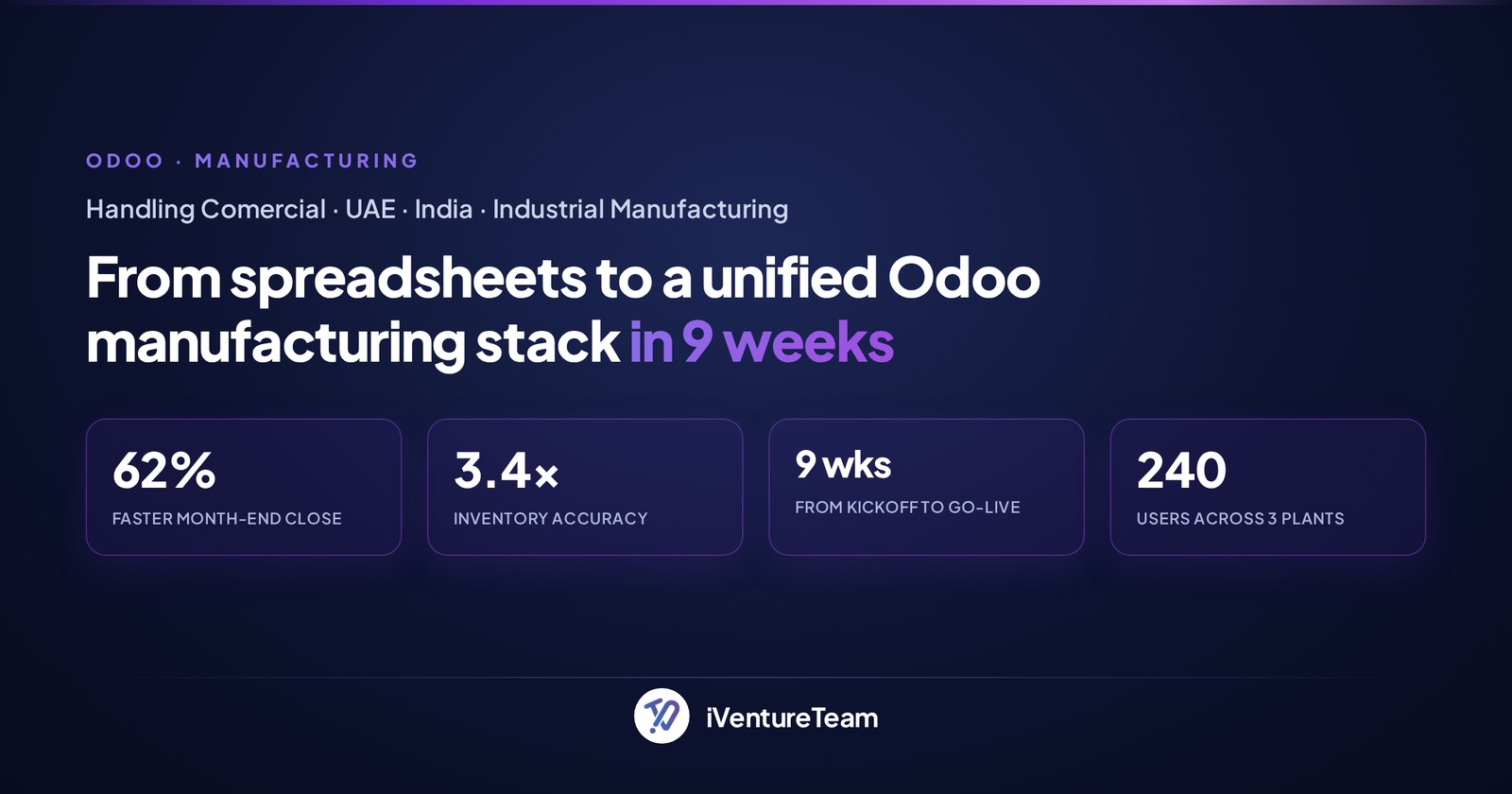
Handling Comercial, a three-plant industrial manufacturer, had already scrapped two ERP attempts. A regional partner and a SAP B1 reseller both slipped past a year, and leadership had lost faith in ERP vendors.
With a disciplined Odoo ERP implementation methodology, we took them live on Odoo across three plants in nine weeks, with zero downtime. Month-end close fell from 11 days to 4.2, stock accuracy rose from 62% to 99.7%, and the data laid the ground for AI-driven forecasting.
Conclusion
Odoo succeeds or fails on the methodology behind it, not the software. The eight phases exist to control the three things that actually sink projects: scope, data, and adoption.
Standardize first, customize last, keep a human on change management, and insist on a rehearsed go-live. Follow the method and Odoo becomes the system your growing business runs on, not the project you have to rescue.
Ready to implement Odoo the right way?
You do not need a year-long program to start. In one free scoping call, we will map your processes, flag the risks that sink rollouts, and lay out a fixed-scope path to go-live.
Book a free Odoo implementation scoping call with our team.
FAQ about Odoo ERP implementation methodology
What is an Odoo implementation methodology?
+
An Odoo implementation methodology is the structured, phase-by-phase process for deploying Odoo, from business discovery through solution design, configuration, data migration, testing, training, go-live, and post-launch support. It controls scope, data quality, and adoption so the project stays predictable.
What are the phases of Odoo ERP implementation?
+
Odoo ERP implementation runs in eight phases: business discovery and requirement analysis, solution design and module planning, configuration and development, data migration and cleansing, testing and quality assurance, user training and change management, go-live and deployment, and post-implementation support and optimization.
How long does an Odoo implementation take?
+
A focused, single-entity Odoo implementation can go live in roughly 8 to 12 weeks. Multi-company or heavily customized projects take longer. Timelines slip most when scope is open-ended, so a fixed scope with weekly demos keeps it on track.
How much does Odoo ERP implementation cost?
+
Cost depends on the number of modules, users, integrations, and customization, not just license price. Data migration and process work usually drive the budget more than the software. A scoped quote for your business beats any single published figure.
Why do Odoo implementations fail?
+
Most fail on internal factors, not the software: unclear requirements, over-customization, dirty data, and no change management. A disciplined methodology with a fixed scope, clean data migration, and role-based training is what prevents these failures.
Do I need an Odoo implementation partner?
+
Most growing businesses do, unless they have in-house Odoo and integration expertise with time to spare. A good Odoo ERP implementation company brings a proven methodology, faster go-live, and lower risk, and hands you a system your team actually adopts.
Ready to put this into action?
Talk to iVentureTeam about Odoo, AI automation, or custom development — get a free, no-obligation consultation.
Free Odoo tools
All tools- Odoo Health CheckVersion, modules, findings and upgrade cost
- Odoo App SelectorWhich apps you need, by industry
- Odoo Project EstimateIndicative cost and timeline in minutes
- Odoo Implementation Cost CalculatorImplementation cost and timeline, in minutes
- Odoo Migration Cost CalculatorVersion jump or legacy ERP, priced in minutes
Continue reading

Over-Customized Odoo: Upgrade Options When You Are Stuck on an Old Version

Odoo Upgrade Verification: Problems That Do Not Surface Until Month-End
