
Is Odoo eCommerce Right for You? Review, Features, Limits, and Real-World Fit (2026)
 Siddharth JambukiyaOdoo Techno-Functional Consultant




Choosing where to build your online store is a decision you live with for years, so the question deserves an honest answer rather than a pitch. This review walks the features, the limits, the comparison, and the fit, and our Odoo eCommerce development team can pressure-test it against your business.
What Odoo eCommerce actually is
Odoo eCommerce is an online store that is part of Odoo itself, sharing one database with inventory, sales, accounting, and CRM, rather than a separate platform you connect to your back office. That single fact shapes every strength and every limit that follows.
You build the storefront with Odoo's Website builder, list products from the same catalog your warehouse uses, and take orders that post straight into sales and accounting. There is no middleware syncing a Shopify store to an ERP, because the store and the ERP are the same system.
For some businesses that is exactly what they want, and for others it is more than they need. To judge which camp you are in, start with what the platform actually does.
The Odoo eCommerce features that matter
Odoo eCommerce covers the core an online store needs: product pages and variants, native SEO, major payment and shipping providers, B2B pricing, and multi-website support, all managed from one back office. These are table stakes, and Odoo meets them.
Products and catalog: product pages, variants, options, cross-sells, and stock shown live from your real inventory.
Payments and shipping: major providers including Stripe, PayPal, Mollie, and Adyen, plus carrier integration with tracking, returns, and refunds.
SEO built in: meta titles and descriptions, clean URLs, sitemaps, Open Graph tags, and a blog module, without buying SEO plugins.
B2B and B2C: customer-specific price lists, logins and portals, and public storefronts, all on the same backbone.
Multi-website: several stores, languages, and currencies from one Odoo instance.
You can confirm the details in Odoo's own eCommerce documentation. Features are only half the story, though; the reason businesses pick Odoo is the architecture behind them.
The real strength: one system, not a stack
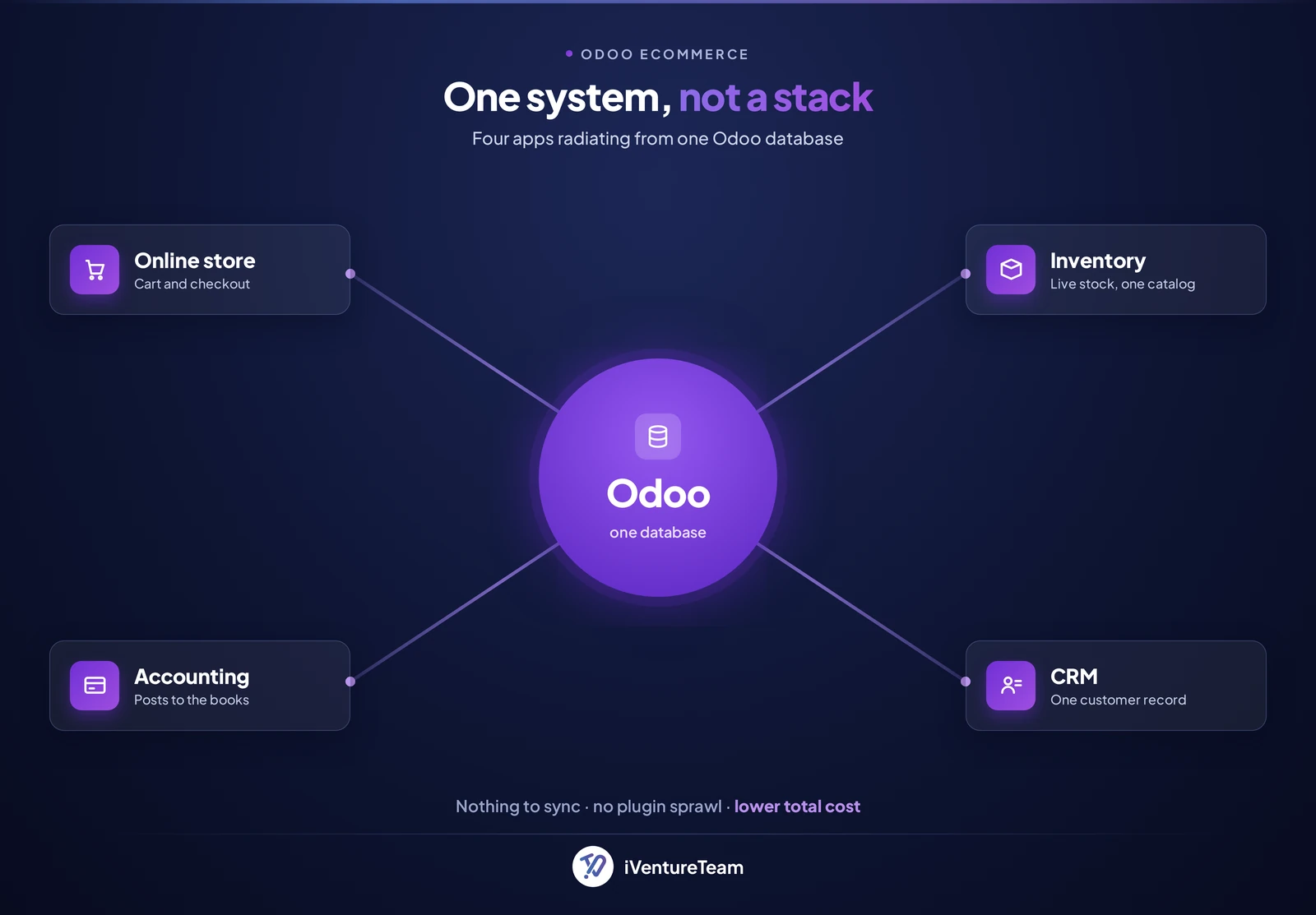
Odoo eCommerce's biggest advantage is that the store, the stock, the customers, and the books are one system, so there is nothing to sync, no plugin sprawl, and a lower total cost of ownership. Most store platforms bolt on the ERP; Odoo starts with it.
When an order comes in, stock decrements, the invoice posts, and the customer record updates in the same instant, because it is all one database. There is no nightly sync to break, no duplicate customer records, and no separate accounting integration to license and maintain.
The same order flows into the same books your finance team already runs, which is why our How Odoo accounting works guide matters here too. That unified backbone is also what makes Odoo unusually strong for B2B.
Where Odoo eCommerce shines: B2B
For B2B sellers, Odoo eCommerce is a genuine strength: customer-specific price lists, hidden or on-request pricing, logins and portals, and one-click reordering come built in, not bolted on. This is where it often beats a B2C-first platform outright.
A logged-in customer sees their own negotiated prices, drawn straight from the same price lists your sales team uses. You can hide prices behind a quote request for confidential deals, give each account a portal for orders and invoices, and let regular buyers reorder in a click.
For a distributor or wholesaler, that removes the add-ons and workarounds a consumer platform needs to fake B2B. But no platform is all upside, and an honest review has to cover the limits.
The honest limits of Odoo eCommerce
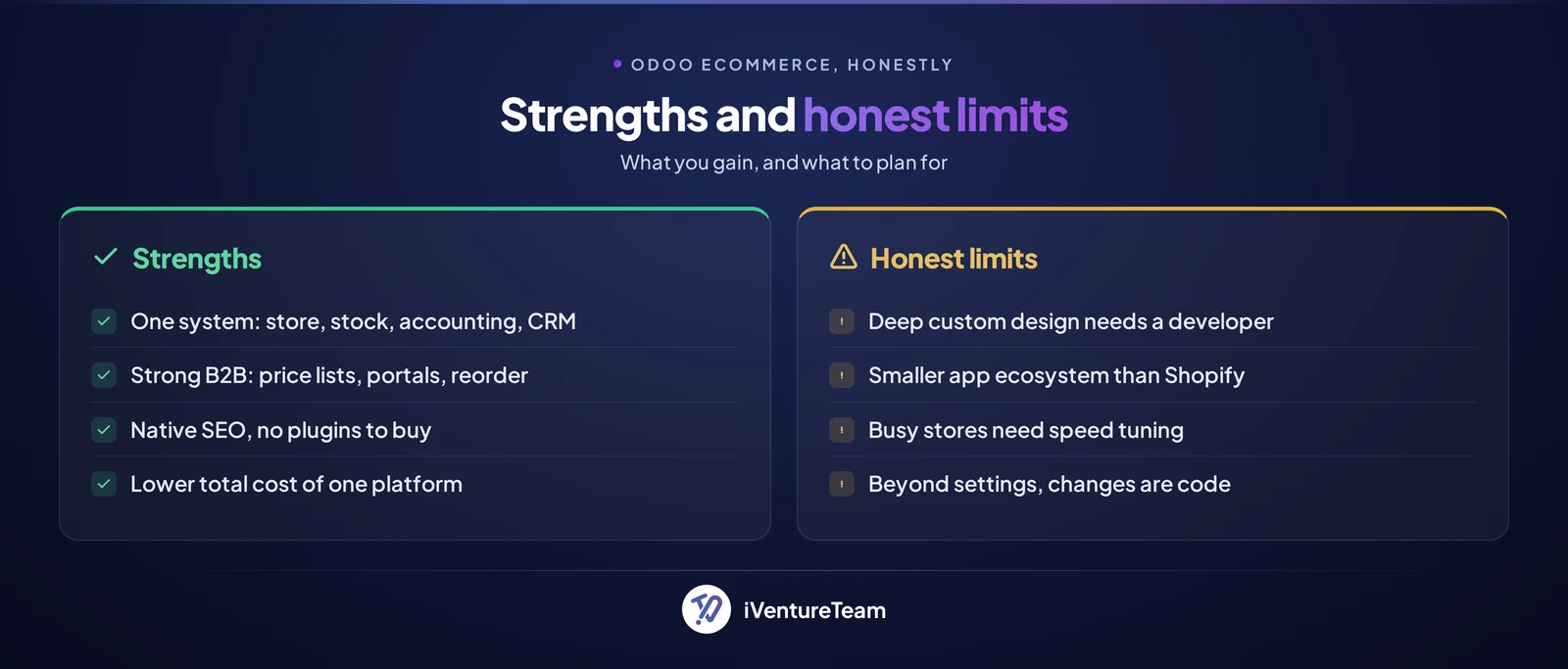
Odoo eCommerce's real limits are design flexibility, a smaller app ecosystem than Shopify, performance tuning at scale, and the fact that heavy customization needs a developer. Know these before you commit, not after.
Design and themes: the Website builder is capable, but pixel-perfect custom design and premium themes are fewer than Shopify's, and deep changes mean QWeb and CSS work, often via Odoo theme development.
App ecosystem: the Odoo Apps store is large, but it is smaller than Shopify's marketplace, so a niche plugin may not exist off the shelf.
Performance: a busy Odoo store can need caching, image, and hosting tuning to hit top page-speed scores, which affects SEO and conversion.
Customization is code: once you go beyond settings, changes are developer work, not drag-and-drop.
Portability: you can migrate off Odoo later, but exporting a deeply integrated store takes planning, so weigh lock-in as you would with any platform.
None of these are dealbreakers for the right business; they are trade-offs. Which brings us to the comparison everyone asks about.
Odoo eCommerce vs Shopify vs WooCommerce
Shopify is the fastest way to a polished standalone store with the biggest theme and app ecosystem; Odoo is the best way to run your store and your whole operation on one system; WooCommerce is the flexible WordPress route you assemble and maintain yourself. Pick by what you are really buying.
Choose Shopify when you are a direct-to-consumer brand that wants design polish, marketing apps, and speed to launch, and you are happy to integrate your ERP separately. Choose WooCommerce when you already live in WordPress and want full control at the cost of doing the assembly.
Choose Odoo when you want the store unified with inventory, accounting, and CRM, when B2B pricing matters, or when you are already an Odoo shop.
Our Odoo vs Shopify vs WooCommerce comparison breaks the three down side by side, but the short version is this: the decision is less about the storefront and more about the system behind it.
Who Odoo eCommerce is right for, and who should look elsewhere
Odoo eCommerce is right for businesses that run, or want to run, their operations on Odoo, and for B2B and inventory-heavy sellers; it is the wrong fit for pure D2C brands who only want a beautiful standalone store. Be honest about who you are.
It fits a wholesaler with complex pricing, a retailer who wants stock and store as one, or a growing business that would rather license one system than five. It fits you especially well if Odoo already runs your back office.
It does not fit a fashion brand that wants a bespoke, design-led storefront and a marketing app for everything, with no interest in the ERP underneath. For them, a dedicated commerce platform is the better tool, and saying so is part of an honest review.
If you are still unsure, the cost and setup will help you decide.
What Odoo eCommerce costs and how to start
The eCommerce store is one app within your Odoo subscription, so it adds little licence cost on its own; the real investment is setup, design, data, and any customization. Budget for the build, not the shop.
On licensing, the Website and eCommerce apps come with Odoo, and Community edition can run a store while Enterprise adds more polish and support. The spend that matters is configuring the catalog, designing the storefront, connecting payments and shipping, and any custom work.
Start with a tight first version: a clean catalog, standard theme, core payments and shipping, and go live, then refine design and add features once real orders are flowing. That keeps the first cost contained and the launch quick.
How iVentureTeam helps you decide and build
iVentureTeam gives you an honest fit assessment first, then designs and builds an Odoo eCommerce store that is fast, integrated, and owned by you. We would rather tell you Odoo is the wrong fit than sell you the wrong build.
Our team reviews your catalog, pricing, and operations, recommends Odoo only where it genuinely fits, and then handles the storefront design, payments and shipping, B2B setup, and performance tuning. Our Odoo for retail and eCommerce build work covers the whole journey, from storefront to stockroom.
That honest, build-it-right approach is what the following project relied on.
Case study: a Dutch retailer scaling on Odoo eCommerce
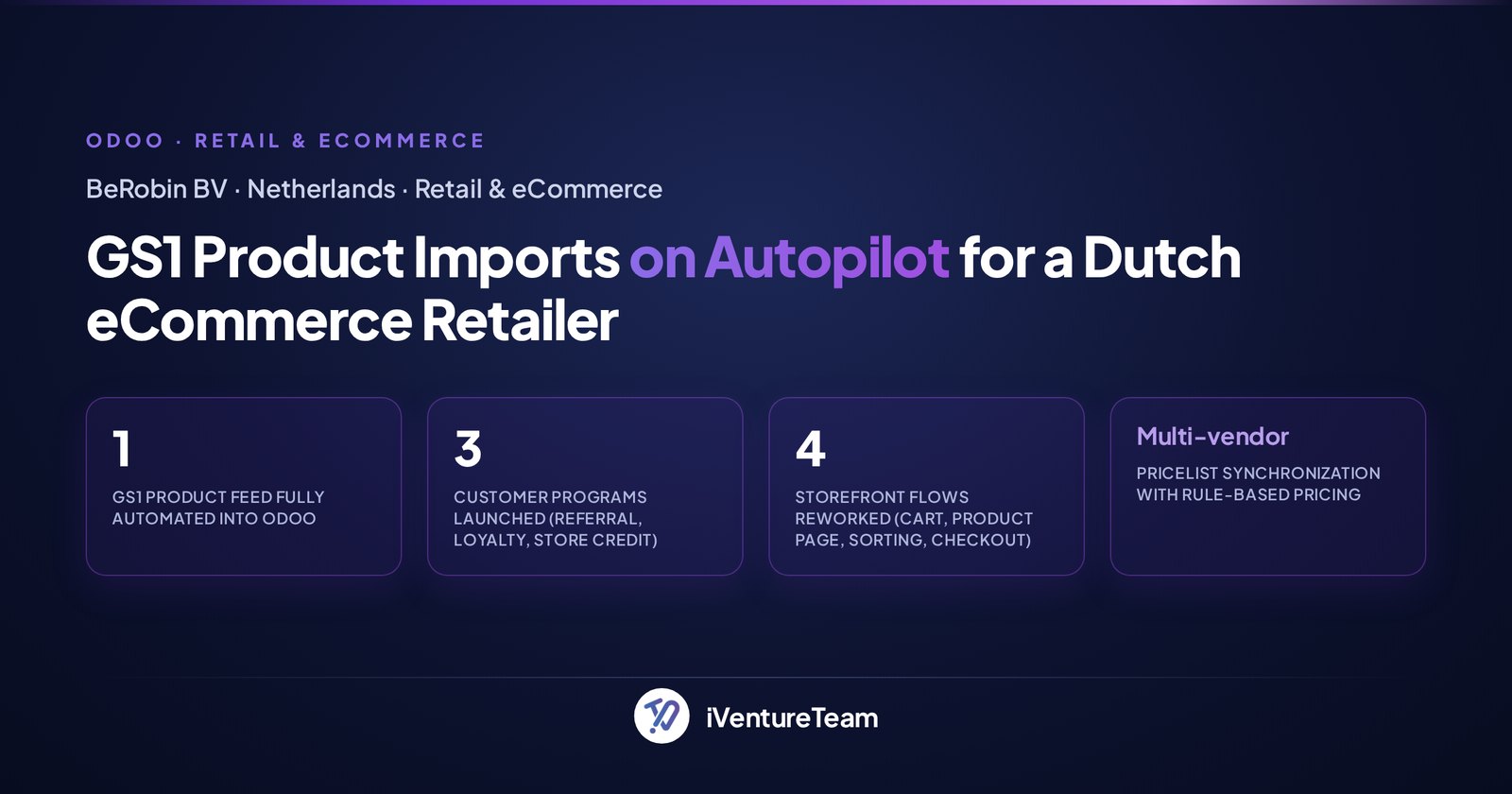
BeRobin, a fast-growing Dutch eCommerce retailer, runs its storefront, loyalty programs, and warehouse on Odoo eCommerce, automating GS1 product imports so the catalog scales without manual data entry. It shows Odoo eCommerce carrying a real, growing online business.
Over a 14-week build, iVentureTeam automated BeRobin's GS1 product feed, built a referral, loyalty, and store-credit engine with live dashboards, added mobile barcode scanning for the warehouse, and reworked the cart-to-checkout flow to be fully responsive.
As their operations manager put it, orders now come in from the webshop and go out the door without anyone retyping product data, with the catalog, customers, and warehouse growing on automation instead of headcount.
The bottom line on Odoo eCommerce
Odoo eCommerce is right for you if you want your store and your operation to be one system, and especially if you sell B2B or already run Odoo; it is the wrong tool if you only want a design-led standalone shop. The storefront is good, but the real value is the system behind it.
Judge it on that, not on themes alone. If a unified operation, strong B2B, and one system instead of five sound like your business, Odoo eCommerce is a serious contender worth a proper look.
Ready to see if Odoo eCommerce fits your business?
You do not have to decide from a feature list alone. In a free 30-minute Odoo eCommerce fit review, a senior Odoo consultant assesses your catalog, pricing, and operations, and tells you honestly whether Odoo is the right platform for you.
Book your free Odoo eCommerce fit review, call +91-93270-18076, or email business@iventureteam.com.
Frequently Asked Questions
Is Odoo eCommerce any good?
+
Yes, for the right business. Odoo eCommerce is strong when you want the store unified with inventory, accounting, and CRM, and for B2B selling. It is less suited to pure design-led D2C brands who only want a standalone storefront and a large app marketplace.
Is Odoo eCommerce better than Shopify?
+
Neither is better outright; they solve different problems. Shopify is faster for a polished standalone store with the biggest app and theme ecosystem. Odoo is better when you want the store and your whole operation, including B2B pricing, on one system rather than integrated separately.
Does Odoo eCommerce work for B2B?
+
Yes, and it is a real strength. Odoo supports customer-specific price lists, hidden or on-request pricing, account logins and portals, and one-click reordering out of the box, drawing on the same price lists and inventory your sales team already uses.
Is Odoo eCommerce good for SEO?
+
Odoo has native SEO tools: editable meta titles and descriptions, clean URLs, sitemaps, Open Graph tags, and a blog module, so you can rank without extra plugins. Page speed on a busy store can need caching and hosting tuning to hit top scores.
How much does an Odoo eCommerce store cost?
+
The Website and eCommerce apps are included in your Odoo subscription, so the store adds little licence cost by itself. The real investment is setup, storefront design, payment and shipping configuration, data, and any customization, which is priced by scope.
Can Odoo eCommerce handle custom design?
+
Yes, but beyond the Website builder's settings, custom design is developer work in QWeb and CSS rather than drag-and-drop, and there are fewer premium themes than on Shopify. For a bespoke storefront, budget for theme development.
Ready to put this into action?
Talk to iVentureTeam about Odoo, AI automation, or custom development — get a free, no-obligation consultation.
Continue reading
![Odoo Support: Complete Guide for Every Business [2026]](https://erp.iventureteam.com/api/blog/image/cover/odoo-support?v=20260927080816)
Need Odoo Support? We're Here to Help for Every Business Type (2026)
Read article
Odoo Upgrade Cost: Complete Guide for All Types of Business Owners [2026]
Read article