
Odoo vs Shopify vs WooCommerce: An Honest 2026 Comparison
 Siddharth JambukiyaOdoo Techno-Functional Consultant




Choosing an eCommerce platform is really a bet on the next three to five years of your business. The fear underneath it is always the same: what if we pick wrong and have to rebuild? Most comparisons don't help, because they're written by someone selling one of the platforms.
We implement Odoo eCommerce for a living, so we have a bias too, and we'll be upfront about it. This guide tells you honestly when Odoo is the wrong choice, and when Shopify or WooCommerce will serve you better.
Which platform should you choose?
The short answer comes down to one question: is commerce your whole business, or one part of it?
Choose Shopify if commerce is your business and you want a store live this week with minimal technical work.
Choose WooCommerce if you already live in WordPress, want full ownership of your data, and don't mind managing hosting.
Choose Odoo if your online store is one part of a bigger operation you want running on one system.
Odoo vs Shopify vs WooCommerce: quick comparison
Here's the at-a-glance version before we dig into each platform:
Factor | Shopify | WooCommerce | Odoo eCommerce |
|---|---|---|---|
Best for | Standalone online stores | WordPress-based stores | Product businesses running whole ops on one system |
Ease of setup | Fastest, wizard-led | Moderate, needs WordPress | Steeper, more to configure |
Base cost | From $39/mo | Free core plus hosting | One App Free, then ~$19.90/user/mo |
Transaction fee | 2.9% + 30¢, plus extra without Shopify Payments | Only your payment processor's fee | Only your payment processor's fee |
B2B support | Needs Plus or apps | Needs extensions | Native |
Built-in back office | No, separate apps | No, separate plugins | Yes, one platform |
Data ownership | Hosted by Shopify | Self-hosted, you own it | You own it, self or Odoo-hosted |
The table shows the shape of the decision. The next three sections explain what each row means in practice, starting with the simplest platform to launch.
Shopify: the fastest way to a working store
If you want a store online with as little friction as possible, Shopify wins. It's a fully hosted platform, so you don't touch servers, security patches, or updates. The setup wizard walks you from sign-up to storefront, and its app store fills almost any gap.
What Shopify costs
The trade-offs are cost and control. On the Basic plan, which starts at $39 a month, Shopify charges 2.9% plus 30¢ on every online card sale, as its official Shopify pricing page lays out.
If you use a payment gateway other than Shopify Payments, Shopify adds its own extra transaction fee on top. Its Shopify Payments cost breakdown shows the exact rates by plan.
For a high-volume store, those percentage fees add up faster than a fixed subscription would. Shopify is also, by design, a storefront: your accounting, inventory, and CRM live in separate tools you pay for individually.
B2B features like customer-specific pricelists usually mean the pricier Plus tier or bolt-on apps as well.
Choose Shopify when: commerce is your core business, you want speed over control, and your operations are simple enough to run storefront-first. If you want that same ownership without the subscription, WooCommerce is the next stop.
WooCommerce: control, if you'll manage it
WooCommerce is the right call when you already run WordPress and want to own your stack. The core plugin is free and open-source, which WooCommerce's own pricing page confirms, so there's no subscription and no per-sale platform fee. You only pay your payment processor.
What WooCommerce actually costs
"Free," though, doesn't mean zero cost. You pay for hosting, usually $25 to $350 a month depending on traffic, as WooCommerce sets out in its guide to store running costs.
On top of that come paid extensions for features Shopify includes out of the box. You're also responsible for updates, security, and making the pieces work together. That responsibility is the point: you get full data ownership and are never locked into one vendor's roadmap.
Choose WooCommerce when: you're content-and-WordPress-led, you value ownership and flexibility, and you have the technical support to maintain it. But if the store is only one part of a bigger operation, neither Shopify nor WooCommerce solves the real problem, which is where Odoo comes in.
Odoo eCommerce: one system for the whole business
Odoo makes sense when your store is a front-end to a larger operation. Its differentiator isn't the storefront itself. It's that the storefront sits on the same database as your inventory, accounting, CRM, purchasing, and B2B logic.
An order placed online updates stock and books the invoice without a single connector or nightly sync. That is the whole point of Odoo: one connected system rather than a stack of separate tools, and recent releases like Odoo 18 and 19 lean further into it.
That is what an Odoo eCommerce vs Shopify decision really comes down to: a standalone storefront, or a storefront wired into the whole business.
How Odoo pricing works
On price, Odoo's model is different again. Its One App Free plan runs a single app free forever for unlimited users, and because eCommerce needs Website and Invoicing, those come included too. Odoo's pricing page spells it out.
Add more apps and it's a flat ~$19.90 per user per month on the Standard plan, so you pay per user, not per feature. Payment fees are just your processor's; Odoo takes no cut. The larger investment is the implementation itself.
When Odoo is worth it, and when it isn't
Here's our honest bias check, from doing these implementations: Odoo rewards businesses with operational complexity and punishes those without it. If you sell a handful of SKUs from a simple catalogue, its depth is overhead you'll feel during setup and won't use.
Where we consistently see it pay off is mid-market product companies, often ones already juggling a separate store, spreadsheet inventory, and disconnected accounting, who consolidate onto one system and stop paying the "integration tax" of stitching tools together.
If you want to sanity-check the numbers for your own case, our Odoo implementation cost guide breaks down what drives the investment.
Choose Odoo when: eCommerce is one department of a bigger business, you need native B2B such as pricelists and multi-company, or you already run or plan to run other operations on Odoo.

Shopify vs WooCommerce: the quick head-to-head
If Odoo isn't in the running and it's really Shopify versus WooCommerce, the split is simple.
Shopify is hosted, faster to launch, and lower-maintenance, but you pay a subscription and live inside its ecosystem. WooCommerce is free to install and fully yours, but you own the hosting, updates, and security.
Pick Shopify for speed and hands-off convenience. Pick WooCommerce for control, ownership, and no platform lock-in, as long as you have the technical support to run it.
Widen the question to Odoo vs WooCommerce and it shifts again: both are open-source and self-hostable, but Odoo adds the inventory, accounting, and B2B back office that WooCommerce leaves to plugins.
Cost comparison: Odoo vs Shopify vs WooCommerce
Cost is usually the deciding factor, so let's put real numbers on it. Sticker price is the wrong thing to compare; what matters is total cost of ownership:
Shopify: a predictable subscription from $39 a month, but percentage transaction fees scale with revenue, and B2B or advanced features push you to higher tiers or paid apps.
WooCommerce: no platform fee, but hosting at $25 to $350 a month, paid extensions, and maintenance time are yours to cover.
Odoo: low or no software cost to start, with One App Free and then about $19.90 per user per month, so the main investment is implementation.
A $50,000 a month example
Take a store doing $50,000 a month with a $50 average order, about 1,000 orders. Card processing costs roughly 2.9% plus 30¢ on all three, because that fee belongs to the payment processor, not the platform: about $1,750 a month either way.
The platforms split on their own cost. Shopify adds its $39 plan, plus an extra fee if you use a gateway other than Shopify Payments, which at this volume can add hundreds of dollars a month, according to Shopify's pricing page.
WooCommerce adds hosting, often $50 to $150 at this volume, plus any paid extensions. Odoo adds roughly $20 per user per month and takes no cut of sales. The honest gap at this scale is smaller than the marketing suggests.
The pattern: Shopify front-loads simplicity and back-loads percentage fees. WooCommerce trades subscription cost for maintenance effort. Odoo trades a bigger upfront setup for a lower, flatter run-rate.
A store doing high volume often finds percentage fees, not subscriptions, become the largest line item over time.
Platform lock-in: which is hardest to leave?
Cost tells you what you'll pay to stay. Lock-in tells you what it costs to leave, and that's the fear underneath most platform decisions.
Shopify hosts everything. You can export data, but your storefront, themes, and app logic live inside Shopify's ecosystem, so leaving means rebuilding.
WooCommerce and Odoo are open-source and self-hostable, so you own the data and the environment. Plan any Odoo migration properly, but you're not dependent on one vendor.
If avoiding lock-in is a priority, the open-source options give you more leverage. If you'd happily trade some lock-in for never touching infrastructure, Shopify's containment is a feature, not a bug.
When NOT to choose each platform
Put cost and lock-in together, and the wrong-fit cases get obvious:
Don't choose Shopify if transaction fees on high volume will dwarf a subscription, or if you need deep B2B and back-office logic without paying for Plus and a stack of apps.
Don't choose WooCommerce if you have no appetite for managing hosting, updates, and security. An unmaintained WooCommerce store is a liability.
Don't choose Odoo if you want a simple standalone store and have no other operations to unify. Its strength is consolidation; without complexity to consolidate, you carry weight you won't use.
How iVentureTeam Helps
If all of that points you toward Odoo, because commerce is one part of a larger operation, here's what working with us actually looks like.
As a certified Odoo partner, we implement Odoo eCommerce as one connected system: storefront, inventory, accounting, and B2B price lists on a single database. An online order flows straight through to stock and invoicing, with no middleware to babysit.
Most teams call us for the messy middle: pulling an existing Shopify or WooCommerce store, marketplace channels, and offline POS into one source of truth, then migrating that data to Odoo without losing SKUs or order history.
And if you're still weighing it up, our Odoo consulting team will stress-test whether Odoo genuinely fits your business before you commit, and say so plainly if it doesn't.
Related case study
We've done exactly this. A retailer came to us on a heavily-customized Odoo 14, running Shopify, Amazon, and four POS terminals as separate islands that never quite agreed on the numbers.
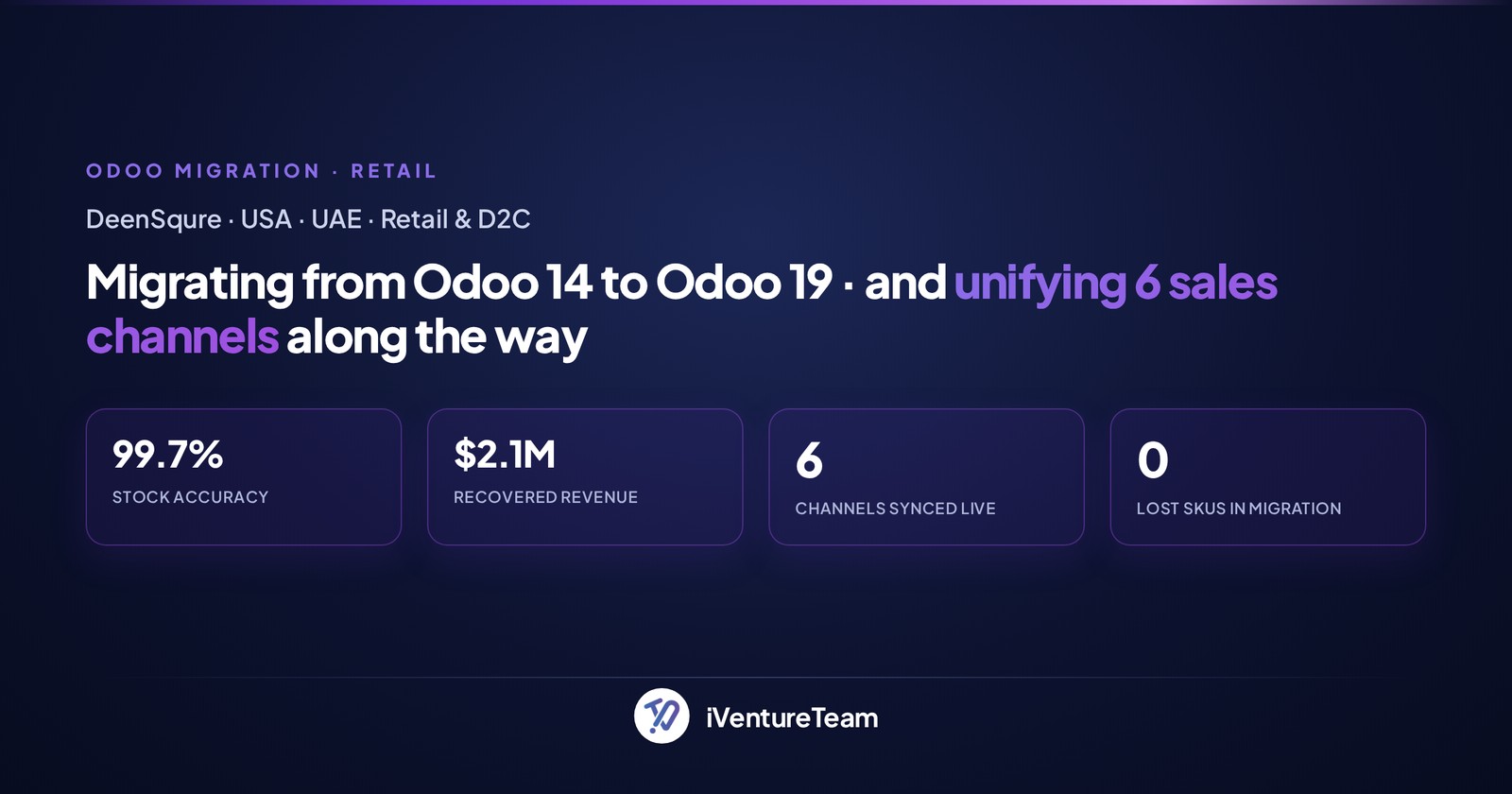
We migrated them to Odoo 19 and unified all six sales channels into one source of truth, reaching 99.7% stock accuracy, $2.1M in recovered revenue, and zero lost SKUs through the migration.
That is the "store as one part of a larger operation" case in practice, the exact situation this comparison keeps pointing back to.
Conclusion
The three platforms aren't really competing for the same job. Shopify is the fastest path to a standalone store, WooCommerce is the owner's choice for WordPress-led businesses, and Odoo is for companies that want commerce and their whole back office on one system.
Match the platform to how your business actually runs, not to whichever tool ranks first, and you avoid the expensive rebuild you were worried about in the first place.
Need Help Choosing Between Odoo, Shopify, and WooCommerce?
Still comparing Odoo, Shopify, and WooCommerce for your business? Share your requirements with our experts, and we'll provide an unbiased recommendation based on your goals, budget, and long-term growth plans.
During a free 30-minute consultation, one of our senior Odoo consultants will review your current systems, assess migration complexity, estimate implementation costs, and recommend the platform that's the best fit for your business. If Odoo isn't the right choice, we'll tell you that too. There is no obligation and no sales pressure.
Explore our Odoo eCommerce Development Services to learn how we build scalable, ERP-powered online stores, or book your free consultation to receive expert guidance tailored to your business.
Frequently Asked Questions About Odoo vs Shopify vs WooCommerce
How does Odoo compare to Shopify?
+
Shopify is a hosted, storefront-first platform: fastest to launch, with a subscription plus per-transaction fees. Odoo is an all-in-one system where eCommerce shares one database with inventory, accounting, and CRM. Shopify wins on speed; Odoo wins when the store is part of a larger operation.
What is the disadvantage of using Odoo?
+
Odoo's main disadvantage is complexity. It has a steeper learning curve and a larger setup effort than a plug-and-play storefront, and that depth is wasted if your business is simple. It pays off with operational complexity and feels like overhead without it.
Who is Shopify's biggest competitor?
+
For standalone stores, WooCommerce is Shopify's largest open-source rival, and BigCommerce a direct SaaS competitor. For businesses wanting commerce plus full back-office operations on one platform, Odoo competes on a different axis, replacing the whole tool stack rather than just the storefront.
How much does Shopify take from a $20 sale?
+
On the Basic plan with Shopify Payments, online card fees are 2.9% plus 30¢, so a $20 sale costs about 88¢ in processing and leaves you roughly $19.12. A third-party gateway adds Shopify's extra fee on top, as Shopify's pricing page shows.
Is Odoo eCommerce good for B2B?
+
Yes. Unlike Shopify, which typically needs the Plus tier or apps for B2B, Odoo handles B2B natively: customer-specific pricelists, multi-company, and quotation workflows are built in and share data with sales and accounting.
Which is best for SEO: Odoo, Shopify, or WooCommerce?
+
All three can rank well; SEO depends more on your content than the platform. WooCommerce has the deepest tooling through WordPress plugins like Yoast and RankMath. Shopify covers the basics cleanly, and Odoo's built-in SEO fields are solid and improving.
Can I move from Shopify or WooCommerce to Odoo later?
+
Yes, though migration takes planning. Product, customer, and order data can be migrated into Odoo; the effort depends on catalogue size and customizations. Our Odoo consulting team can map the path before you commit.
Ready to put this into action?
Talk to iVentureTeam about Odoo, AI automation, or custom development — get a free, no-obligation consultation.


