Top 20+ Powerful ERP Software for Small Businesses in the UK (2026)
 Siddharth JambukiyaOdoo Techno-Functional Consultant




Choosing ERP for a UK small business is not the same as picking a global system, because VAT, Making Tax Digital, payroll, and UK support all shape the decision. The 20+ ERP software examples here are weighted to what actually works for a British SMB.
What counts as ERP for a small business
ERP software runs a small business's core operations, accounting, inventory, sales, purchasing, and often CRM and payroll, from one shared database, so data is entered once and everyone sees the same numbers. That single system of record is what separates ERP from a stack of disconnected apps.
The catch for small businesses is that many popular tools marketed alongside ERP are really accounting-first. Xero and QuickBooks, for example, are excellent books but are not full ERP until you bolt on inventory, manufacturing, or project modules from elsewhere.
We flag that difference throughout, because buying an accounting package expecting full ERP is the most common and costly mistake a growing UK small business makes.
When does a UK small business actually need ERP?
A small business needs ERP when its separate tools stop keeping up: stock figures drift, the same order is re-keyed into three apps, month-end drags on for days, or every report means stitching spreadsheets together. When that starts, you have outgrown accounting software.
Clear signs you are ready: you sell across more than one channel, you hold stock that is hard to track, you run more than one company or currency, or your team loses hours moving data between apps that do not talk to each other.
Just as important is knowing when to wait. A sole trader or micro business on Xero or QuickBooks with no inventory rarely needs full ERP yet, and forcing one in early adds cost and complexity for little gain. Fix the bottleneck, not the label.
Once you are sure you need ERP, the next question is what a UK business specifically requires of it.
What UK small businesses specifically need
A UK small business needs an ERP that handles VAT and Making Tax Digital, works in pounds and UK payroll, keeps data under UK or EU hosting, and comes with support in your timezone. These UK-specific factors matter more than any global feature checklist.
Making Tax Digital is now unavoidable. Making Tax Digital for VAT already applies to all VAT-registered businesses, and from 6 April 2026 Making Tax Digital for Income Tax began for sole traders and landlords earning over £50,000, per HMRC's Making Tax Digital guidance.
So your ERP must keep digital records and files through compatible software. Our Odoo HMRC and MTD compliance guide walks through exactly how that works in practice for one system.
Beyond tax, weigh UK-based implementation support, GDPR-friendly hosting, and sector fit. With those in mind, here is the field.
The 20+ ERP software for UK small businesses
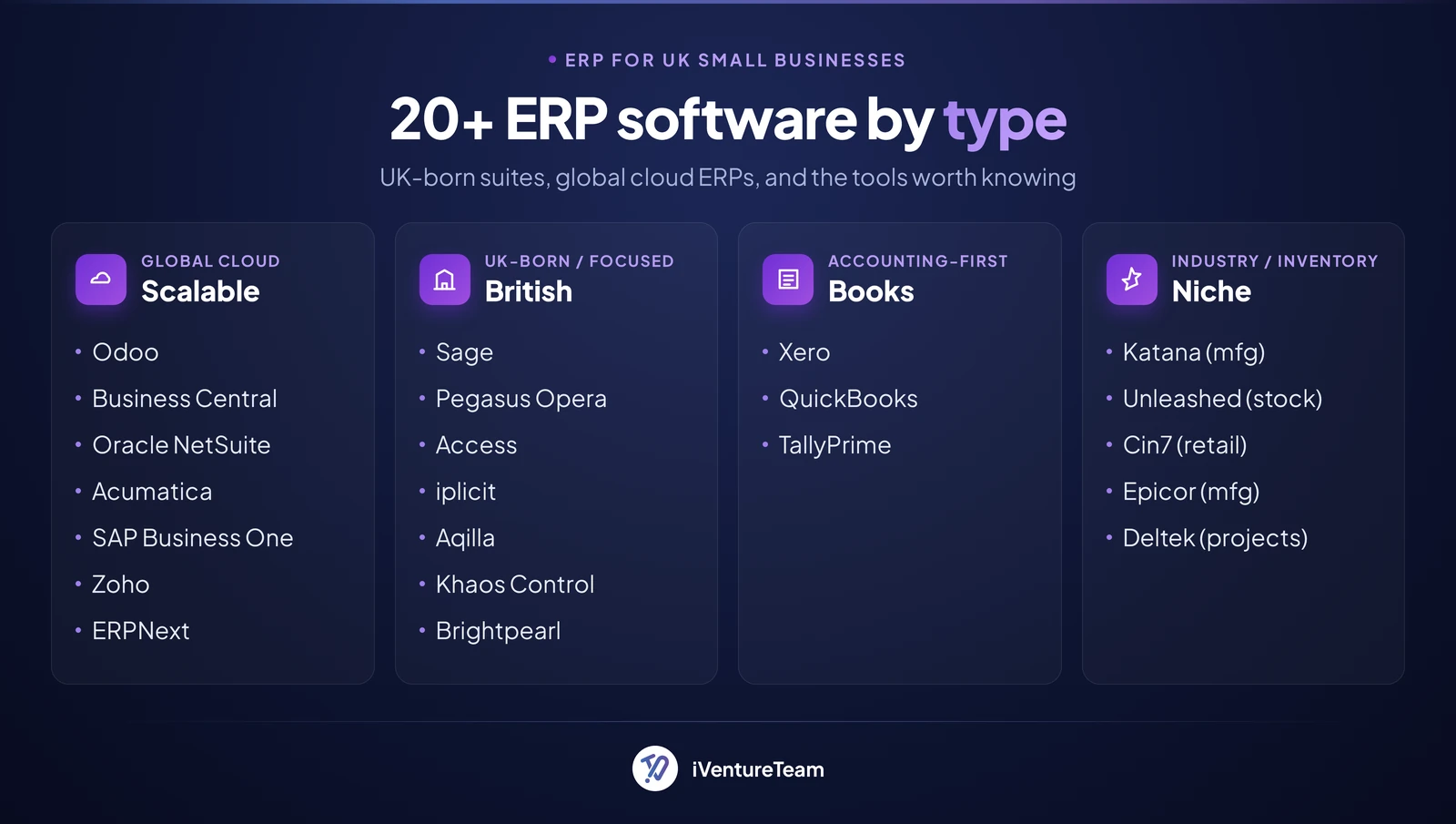
The 20+ options below are grouped four ways: global cloud suites that scale down to SMBs, UK-born and UK-focused systems, accounting-first tools that many firms start on, and industry or inventory-led ERPs. The table after the list compares them at a glance.
Global cloud suites: Odoo, Microsoft Dynamics 365 Business Central, Oracle NetSuite, Acumatica, SAP Business One, Zoho, ERPNext.
UK-born and UK-focused: Sage, Pegasus Opera 3 SE, Access, iplicit, Aqilla, Khaos Control, Brightpearl.
Accounting-first (not full ERP): Xero, QuickBooks, TallyPrime.
Industry and inventory-led: Katana, Unleashed, Cin7, Epicor Kinetic, Deltek.
ERP software | Best for a UK small business | Type | Deployment | Pricing model |
|---|---|---|---|---|
One modular suite that scales from micro to mid-market | Full ERP | Cloud, on-premise, open-source | Per-app or free Community | |
Firms already on Microsoft 365 | Full ERP | Cloud | Per-user/month | |
Fast-growing SMBs wanting one global system | Full ERP | Cloud | Quote-based | |
Growing teams that dislike per-user fees | Full ERP | Cloud | Consumption-based | |
Product businesses wanting a known name | Full ERP | Cloud, on-premise | Per-user licence | |
Micro and small firms on a tight budget | Suite, light ERP | Cloud | Per-user/month | |
Open-source SMBs and technical teams | Full ERP | Cloud, self-hosted | Free or paid cloud | |
UK finance-led SMBs wanting a familiar name | Full ERP, finance | Cloud, on-premise | Subscription | |
UK SMEs wanting finance, payroll, and stock in one | Full ERP | On-premise, cloud | Quote-based | |
UK firms wanting modular finance and operations | Full ERP, finance | Cloud | Quote-based | |
UK firms outgrowing entry-level accounting | Accounting-first | Cloud | Subscription | |
UK mid-market finance and multi-entity | Accounting-first | Cloud | Subscription | |
UK multichannel retail and wholesale | Full ERP | Cloud, on-premise | Quote-based | |
UK retail and wholesale operations | Full ERP, retail | Cloud | Quote-based | |
UK micro businesses and accounting-led firms | Accounting-first | Cloud | Monthly subscription | |
UK sole traders and small firms, accounting-led | Accounting-first | Cloud | Monthly subscription | |
Small firms wanting accounting and inventory | Accounting-first | On-premise, cloud | Licence | |
Small manufacturers needing MRP | Manufacturing ERP | Cloud | Monthly subscription | |
Inventory-heavy wholesale and distribution | Inventory | Cloud | Monthly subscription | |
Retail and wholesale with many channels | Inventory, retail | Cloud | Subscription | |
Small to mid manufacturers | Manufacturing ERP | Cloud, on-premise | Quote-based | |
Project-based and professional services | Project ERP | Cloud | Quote-based |
The global cloud suites, Odoo, Business Central, NetSuite, Acumatica, SAP Business One, Zoho, and ERPNext, give a UK SMB one integrated system that grows with it. If you are weighing these against each other, our Odoo vs NetSuite and ERPNext vs Odoo breakdowns help.
The UK-born tier, Sage, Pegasus Opera, Access, iplicit, Aqilla, Khaos Control, and Brightpearl, is built around UK accounting, payroll, and support. Sage and Pegasus are long-standing UK SME names, while Khaos Control and Brightpearl specialise in British multichannel retail.
The accounting-first tools, Xero, QuickBooks, and TallyPrime, are where most UK small firms start. They are superb books, but treat them as a stepping stone: once stock, manufacturing, or multi-entity needs arrive, you are looking at a true ERP.
The industry and inventory tier, Katana, Unleashed, Cin7, Epicor, and Deltek, is built for one job, manufacturing, stock, or projects, and often beats a general ERP within its niche.
What ERP software costs for a UK small business
ERP pricing spans a wide range, so the model matters more than any single figure: entry tools charge a low monthly fee, cloud ERPs bill per user or per month, and mid-range and UK-specialist systems are priced by quote on scope. Budget the total, not the sticker.
As rough anchors checked in August 2026 (always reconfirmed, as vendors change prices): accounting-first tools like Xero start around £16 a month, and Odoo and ERPNext can start free on their open-source Community editions.
Cloud inventory and manufacturing ERPs sit higher: Unleashed starts around $99 a month and Katana around $299 a month, both billed in US dollars, with free or entry tiers on some plans.
Full-suite and UK-born systems, from NetSuite and SAP Business One to Sage, Pegasus, and Khaos Control, are priced by quote on users, modules, and implementation. Count licences plus setup, customisation, and support in pounds, and get a written quote first.
Quick picks by UK small-business need
In short: budget starters lean Zoho or Xero; retail and wholesale suit Brightpearl, Khaos Control, or Cin7; manufacturers want Katana or Odoo; and firms wanting one system that scales pick Odoo, Business Central, or NetSuite. Start there, then validate.
Startup or tight budget: Zoho, Xero, or Odoo Community for cost and speed.
Retail and wholesale: Brightpearl, Khaos Control, or Cin7 for multichannel stock.
Manufacturing: Katana or Odoo for lighter needs, Epicor for more complex plants.
Professional services: Deltek, or Odoo for a cheaper, broader alternative.
One system that scales: Odoo, Dynamics 365 Business Central, or NetSuite.
A shortlist is only the start; choosing well takes a method.
How to choose the right ERP for your UK business
Choose a UK small-business ERP by matching five things: your sector, your Making Tax Digital and VAT duties, your budget including implementation, your deployment preference, and the quality of UK-based support, then shortlist two or three and run a real demo. Buy the fit, not the brand.
Sector fit: a manufacturer needs MRP; a retailer needs multichannel stock; a services firm needs project accounting.
MTD and VAT: confirm the system keeps digital records and files VAT, and is ready for Making Tax Digital for Income Tax.
Total cost: count licences, implementation, and support in pounds, not just the monthly sticker price. Our Odoo implementation cost guide shows how to budget it.
Deployment and data: cloud for less IT overhead, on-premise for control, with UK or EU hosting for GDPR comfort.
UK support: an UK Odoo developer or partner who implements in your timezone matters more than a big global logo.
Get those right and the shortlist writes itself. For many UK SMBs, one open-source name keeps appearing on it.
How iVentureTeam helps UK small businesses choose and implement ERP
Odoo is an open-source, modular ERP that unifies accounting, stock, sales, and CRM, handles UK VAT and Making Tax Digital, and scales as you grow. iVentureTeam is an Odoo partner that helps UK businesses decide whether it fits. We would rather steer you right than sell the wrong system.
We already work with UK clients, from fleet-technology firm CloudTRACK to European SMBs, and we implement remotely across the UK, London to Manchester to Edinburgh, so location is never a barrier. You can read why UK businesses are moving to Odoo for the wider trend.
Odoo is not right for every firm, and part of our job is saying so when Sage, Business Central, or another system fits better. Our Odoo implementation services and UK-focused Odoo implementation partner team cover scoping to go-live. The proof is in projects like the one below.
Case study: a phased Odoo ERP rollout for a growing small business
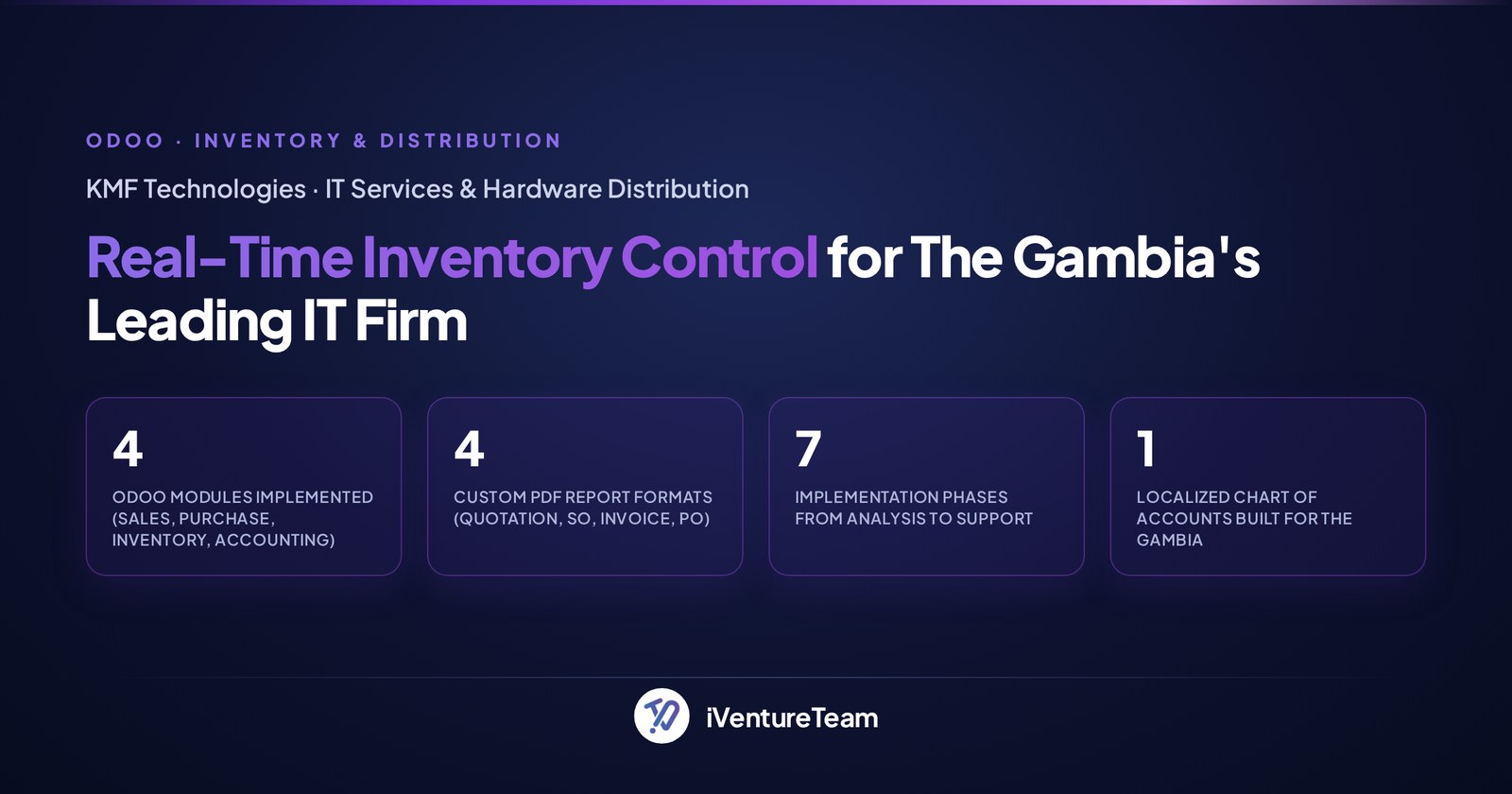
KMF Technologies, a small technology and hardware firm, replaced manual stock tracking with one Odoo ERP spanning Sales, Purchase, Inventory, and Accounting, built on a localised chart of accounts and rolled out in phases. It shows how a small business gets ERP live without disruption.
iVentureTeam implemented four Odoo modules, built four custom PDF document formats covering quotations, sales orders, invoices, and purchase orders, migrated the master data, and trained staff through a seven-phase go-live from analysis to support.
The localised chart of accounts is the detail that matters for a UK reader: it is exactly the same work that makes an ERP file UK VAT correctly, proving the approach that keeps a British small business compliant from day one.
The bottom line on ERP software for UK small businesses
There are dozens of ERP options, but for a UK small business the right one fits your sector, your Making Tax Digital duties, and your budget, not the biggest name on the list. The 20+ examples here give you the field; the table and quick picks give you a shortlist.
For the full global picture beyond the UK, see our wider ERP systems and software examples guide. Whichever you choose, the winning move is the same: match the system to your business, then implement it properly.
Ready to find the right ERP for your UK business?
You do not have to evaluate the whole UK market alone. In a free 30-minute ERP fit call, a senior Odoo consultant will review your operations and Making Tax Digital duties and tell you honestly which ERP, Odoo or otherwise, suits your business, size, and budget.
Book your free UK ERP fit call, call +91-93270-18076, or email business@iventureteam.com.
Frequently Asked Questions about ERP software for UK small businesses
What is the best ERP software for a small business in the UK?
+
There is no single best; it depends on your sector and budget. UK-born names like Sage and Pegasus suit finance-led firms, Brightpearl and Khaos Control suit retail, and Odoo, Business Central, and NetSuite suit firms wanting one system that scales. Shortlist two or three and run a demo.
Is Odoo good for a UK small business?
+
Yes, for the right business. Odoo is an open-source, modular ERP that unifies accounting, stock, sales, and CRM, handles UK VAT and Making Tax Digital, and scales as you grow. It suits SMBs wanting one integrated system without enterprise pricing.
Does ERP software handle Making Tax Digital and VAT?
+
Good ERP systems keep digital VAT records and file through MTD-compatible software. MTD for VAT applies to all VAT-registered businesses, and MTD for Income Tax began in April 2026 for sole traders and landlords over £50,000. Always confirm a system is MTD-ready before buying.
What is the difference between ERP and accounting software like Xero?
+
Accounting software like Xero or QuickBooks runs your books, invoicing, and VAT. ERP does that and adds inventory, purchasing, manufacturing, CRM, and more in one database. Many UK small firms start on accounting software and move to ERP once stock or multi-department needs arrive.
How much does ERP software cost for a small UK business?
+
It varies widely by system and scope. Accounting-first tools are the cheapest, open-source options like Odoo Community can start free, and the real expense is implementation, customisation, and support. Budget the total cost in pounds, not just the monthly licence, before committing.
Can a small business run ERP in the cloud?
+
Yes, most modern ERPs are cloud-first, which suits small businesses because it removes server costs and IT overhead. Look for UK or EU hosting for GDPR comfort, and confirm the vendor's uptime and backup terms. On-premise remains an option where you need full control of data.
Ready to put this into action?
Talk to iVentureTeam about Odoo, AI automation, or custom development — get a free, no-obligation consultation.
Continue reading

Odoo 25% Legacy Surcharge: What It Costs Odoo 17 and Older Users (2026 to 2027)
Read article
Failed Odoo Implementation: What a Broken Go-Live Actually Costs (4 Rescue Projects)
Read article