Best 22+ ERP Systems and Software Examples (2026): The Complete List
 Siddharth JambukiyaOdoo Techno-Functional Consultant




Picking an ERP is a decision your business lives with for a decade, so it helps to see the whole field before you shortlist. The 22+ ERP systems and software examples here, from tier-one giants to lean open-source suites, cover the systems most businesses actually evaluate.
What is an ERP system?
An ERP, or Enterprise Resource Planning system, connects a company's core processes, accounting, inventory, sales, purchasing, and HR, into one platform with a single database. Instead of separate tools that do not talk to each other, everything runs in one place.
The point is a single source of truth. A sale updates stock and the ledger together, a purchase order flows into receiving and payables, and managers see real numbers without stitching spreadsheets. It matches the standard definition of enterprise resource planning.
That single-system idea is what unites every example below, even though they differ hugely in size, price, and focus. Before the list, it helps to know the main types.
Types of ERP systems
ERP systems are grouped three ways: by deployment (cloud, on-premise, or hybrid), by company size (enterprise, mid-market, or small business), and by focus (general-purpose or industry-specific). Knowing which type you need narrows the field fast.
Cloud ERP is hosted by the vendor and is now the default for most businesses, on-premises runs on your own servers for full control, and hybrid mixes both.
On size, tier-one suites fit global enterprises while lean suites fit a ten-person firm. On focus, some ERPs try to do everything, and others are built for one industry like manufacturing or projects.
With those axes in mind, here is the field.
The 22+ ERP systems and software examples
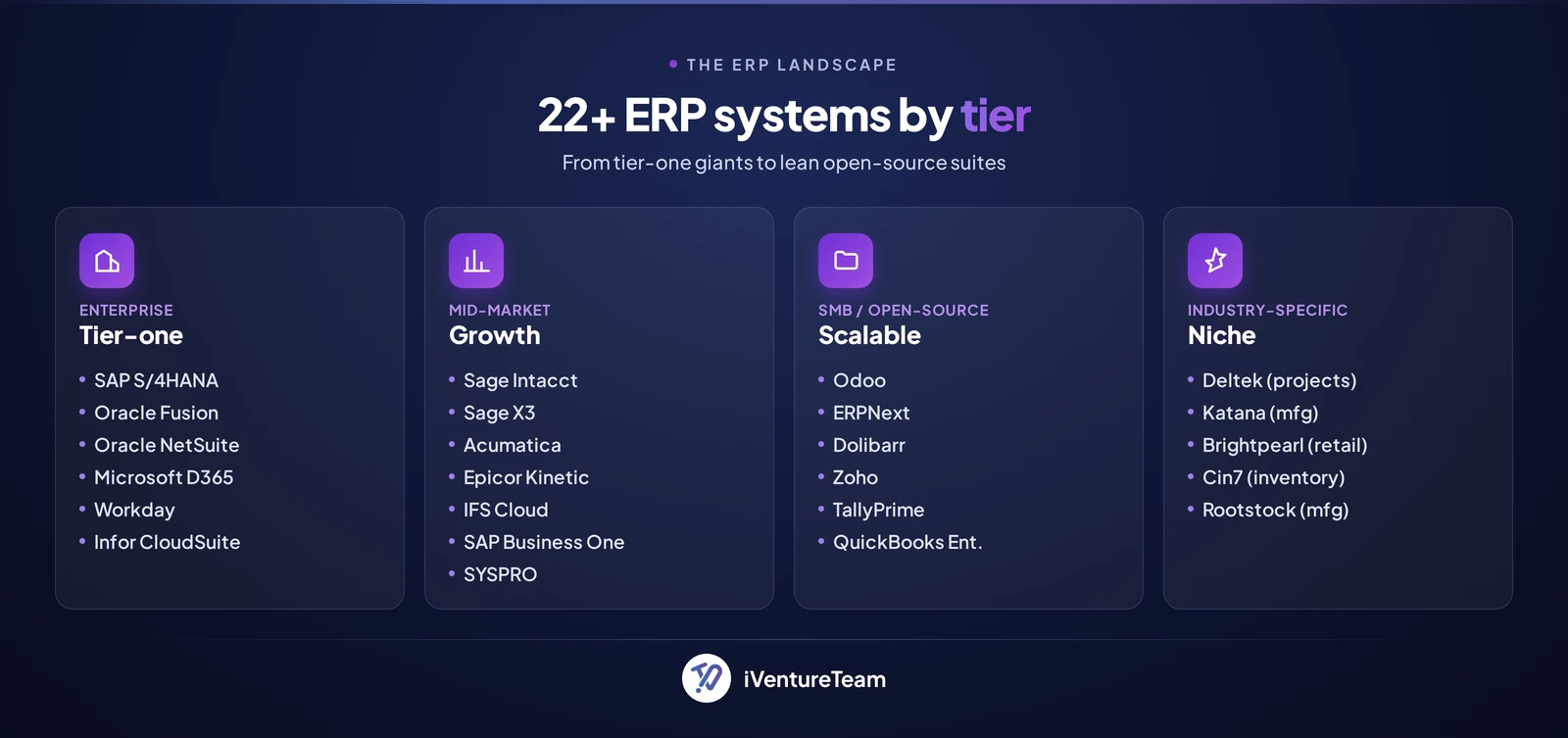
Enterprise: SAP S/4HANA, Oracle Fusion Cloud ERP, Oracle NetSuite, Microsoft Dynamics 365, Workday, Infor CloudSuite.
Mid-market: Sage Intacct, Sage X3, Acumatica, Epicor Kinetic, IFS Cloud, SAP Business One, SYSPRO.
Small-business and open-source: Odoo, ERPNext, Dolibarr, Zoho, TallyPrime, QuickBooks Enterprise.
Industry-specific: Deltek, Katana, Brightpearl, Cin7, Rootstock.
ERP system | Best for | Deployment | Pricing model |
|---|---|---|---|
Large enterprises with complex finance and manufacturing | Cloud, on-premise | Quote-based, high | |
Large enterprises, finance and supply chain | Cloud | Quote-based | |
Fast-growing mid-market to enterprise | Cloud | Per-user plus modules | |
Firms already on the Microsoft stack | Cloud | Per-user subscription | |
Large enterprises, HR-led finance | Cloud | Quote-based | |
Industry-specific enterprises | Cloud | Quote-based | |
Finance-led mid-market | Cloud | Subscription | |
Mid to large manufacturing and distribution | Cloud, on-premise | Quote-based | |
Mid-market wanting unlimited users | Cloud | Consumption-based | |
Mid-market manufacturers | Cloud, on-premise | Quote-based | |
Asset-intensive industries and field service | Cloud | Quote-based | |
Small and mid-sized businesses | Cloud, on-premise | Per-user license | |
Manufacturing and distribution | Cloud, on-premise | Quote-based | |
SMBs to large enterprises wanting one modular suite | Cloud, on-premise, community | Per-app or free Community | |
Open-source SMBs and developers | Cloud, self-hosted | Free open-source or paid cloud | |
Small businesses on a budget | Cloud | Per-user subscription | |
Small businesses, accounting and inventory | On-premise, cloud | License | |
Small US businesses, accounting-led | Desktop, cloud | Subscription | |
Small businesses wanting free open-source ERP and CRM | Cloud, self-hosted | Free open-source or paid modules | |
Project-based and professional services | Cloud | Quote-based | |
SMB manufacturing and inventory | Cloud | Per-user subscription | |
Retail and wholesale operations | Cloud | Quote-based | |
Inventory-centric retail and wholesale | Cloud | Subscription | |
Manufacturers running on the Salesforce platform | Cloud | Quote-based |
The enterprise tier, SAP, Oracle, Microsoft, Workday, and Infor, powers the world's largest companies with deep functionality, long implementations, and quote-based pricing in six or seven figures. If you are comparing Odoo to these, our Odoo vs SAP and Odoo vs NetSuite breakdowns help.
The mid-market tier, Sage, Acumatica, Epicor, IFS, SAP Business One, and SYSPRO, targets growing companies that have outgrown small-business tools but do not need a tier-one suite. These balance capability against cost and time to go live.
The small-business and open-source tier, Odoo, ERPNext, Dolibarr, Zoho, TallyPrime, and QuickBooks Enterprise, is where most SMBs start: lower cost, faster setup, and open-source flexibility in Odoo, ERPNext, and Dolibarr. See our ERPNext vs Odoo and Odoo vs Zoho comparisons.
Do not read open-source as small-only. Odoo in particular scales from a lean team to a large, multi-entity enterprise when it is architected and implemented properly, which is exactly where an experienced partner earns its keep.
The industry-specific tier, Deltek, Katana, Brightpearl, Cin7, and Rootstock, is built for one job, projects, manufacturing, or retail, and often beats a general ERP within its niche. Which one is right depends on your specific need.
Quick picks by need
In short: enterprise picks are SAP or Oracle; mid-market, Acumatica or NetSuite; small-business and open-source, Odoo or ERPNext; manufacturing, Epicor or Katana; retail, Brightpearl or Cin7. Start there, then validate against your specifics.
Small business or startup: Odoo, ERPNext, or Zoho for cost, speed, and simplicity.
Mid-market growth: Acumatica, Oracle NetSuite, or Microsoft Dynamics 365.
Manufacturing: Epicor, SYSPRO, or Katana for lighter needs.
Retail and wholesale: Brightpearl or Cin7 for inventory-led operations.
Projects and services: Deltek, or Odoo for a lighter, cheaper alternative.
A shortlist is only the start; choosing well takes a real method.
How to choose the right ERP for your business
Choose an ERP by matching five things to your business: company size, industry fit, deployment preference, total budget, and integration and reporting needs, then shortlist two or three and run a proper demo. Buy the fit, not the brand.
Size and complexity: do not buy a tier-one suite for a 20-person firm, or outgrow a starter tool in a year.
Industry fit: a manufacturer needs strong MRP; a services firm needs project accounting.
Deployment: cloud for less IT overhead, on-premise for full control, or open-source for both.
Total cost: count licences, implementation, customization, and support, not just the sticker price.
Integrations and reporting: confirm it connects to your other tools and answers the questions your managers actually ask.
Get those right and the shortlist writes itself. For many SMBs, one name keeps appearing on it.
How iVentureTeam helps you choose the right ERP
Odoo is an open-source, modular ERP that unifies your core operations at a fraction of tier-one cost, and, implemented well, it scales from a small team to a large enterprise. iVentureTeam is an Odoo partner who helps you decide whether it fits. We steer you right, not toward the wrong system.
Odoo suits businesses that want one integrated system without enterprise pricing, and that value the option to start small and add modules over time. It is not the answer for every company, and part of our job is saying so when another ERP fits better.
Our Odoo implementation services cover scoping to go-live, and our Odoo ERP implementation guide walks the decisions an owner makes along the way. The proof is in projects like the one below.
Case study: one Odoo ERP for a Belgian chemicals firm
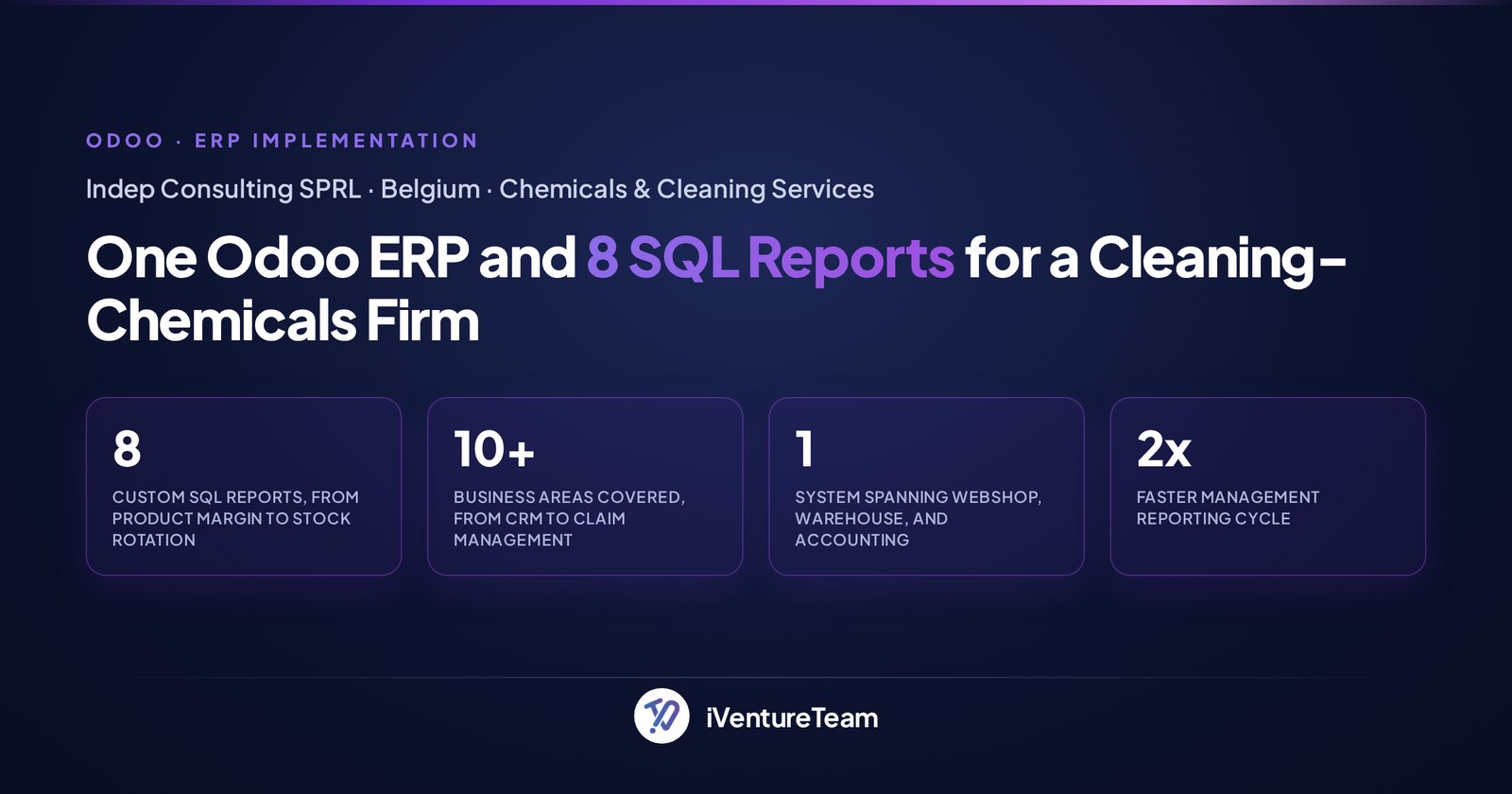
Indep Consulting, a Belgian cleaning-chemicals company, consolidated sales, inventory, accounting, eCommerce, and contract servicing onto one Odoo ERP, with eight custom reports that cut its management-reporting cycle in half. It shows what a well-chosen ERP does for a growing business.
Over a 12-week build, iVentureTeam rolled out Sales, CRM, Inventory, and Accounting as the core, customized the webshop, set up customer pricelists, intercompany transfer rules, and EDI, and wrote eight SQL-based reports covering margin, stock rotation, and contracts.
As their managing partner put it, the reports they could never get out of the old setup are now one click away, and decisions that used to wait for month-end happen the same day, all from one system spanning webshop, warehouse, and accounting.
The bottom line on ERP systems and software
There are dozens of ERP systems, but they sort into four tiers, and the right one is the one that fits your size, industry, budget, and integration needs, not the biggest name on the list. The 22+ examples here give you the field; the table and quick picks give you a shortlist.
Whether you land on a tier-one suite, a mid-market platform, or an open-source option like Odoo, the winning move is the same: match the system to your business, then implement it properly.
Ready to find the right ERP for your business?
You do not have to evaluate the whole market alone. In a free 30-minute ERP fit consultation, a senior Odoo consultant will review your operations and tell you honestly which ERP, Odoo or otherwise, suits your business, size, and budget.
Book your free ERP fit consultation, call +91-93270-18076, or email business@iventureteam.com.
Frequently Asked Questions
What are examples of ERP systems?
+
Common ERP examples include SAP S/4HANA, Oracle NetSuite, Microsoft Dynamics 365, and Workday at the enterprise level; Sage, Acumatica, and Epicor in the mid-market; and Odoo, ERPNext, Zoho, and QuickBooks Enterprise for small businesses. Industry-specific ones include Deltek, Katana, and Cin7.
What is an ERP system in simple terms?
+
An ERP system is one piece of software that runs a company's core operations, finance, inventory, sales, purchasing, and more, from a single shared database. Data is entered once and used everywhere, so everyone works from the same accurate numbers instead of disconnected tools.
What are the main types of ERP systems?
+
The main types are grouped by deployment (cloud, on-premise, or hybrid), by company size (enterprise, mid-market, or small business), and by focus (general-purpose or industry-specific). Most modern ERPs are cloud-based, and some are built for one industry such as manufacturing or retail.
What is the best ERP for a small business?
+
For small businesses, Odoo, ERPNext, and Zoho are strong choices because they are affordable, quick to set up, and integrated. Odoo and ERPNext are open-source and modular, while QuickBooks Enterprise suits accounting-led US firms. The best pick depends on your industry and budget.
How much does an ERP system cost?
+
It varies enormously. Enterprise ERPs like SAP or Oracle are quote-based and run into six or seven figures with implementation. Mid-market systems cost less, and small-business or open-source options like Odoo or ERPNext are the most affordable, with the real spend being setup and customization.
Is Odoo a good ERP system?
+
Yes, for the right business. Odoo fits small and mid-sized companies that want one integrated, modular system without enterprise pricing, and, implemented correctly, it also scales to large, multi-entity organizations. Only the most complex tier-one requirements typically still favor SAP or Oracle.
Ready to put this into action?
Talk to iVentureTeam about Odoo, AI automation, or custom development — get a free, no-obligation consultation.
Continue reading

Running an Unsupported Odoo Version: Your Real Security Exposure (2026)
Read article![Odoo Support: Complete Guide for Every Business [2026]](https://erp.iventureteam.com/api/blog/image/cover/odoo-support?v=20260929035253)
Need Odoo Support? We're Here to Help for Every Business Type (2026)
Read article