AI Agent Development: Should You Build In-House or Hire a Company? (2026 Decision Guide)
 Siddharth JambukiyaOdoo Techno-Functional Consultant




Every team that wants an AI agent hits the same fork: build it with your own engineers, assemble it on a no-code platform, or hire an AI agent development company to deliver it. Choose wrong and you either pay for a team you cannot keep busy or ship an agent that breaks in front of real users.
This guide is the decision, not a vendor list: what building an AI agent actually takes, what each path costs and how long it takes, and a scorecard to choose. If you decide to hire, our AI agent development services show how a production build runs end to end.
What is AI agent development?
AI agent development is the work of building software that uses a large language model to take actions, not just answer questions. An agent plans steps, calls tools and APIs, queries data, remembers context, and completes a task end to end.
That is the key difference from a chatbot. An AI chatbot replies; an AI agent does the thing, for example drafting a quote in your ERP, triaging a support ticket, or reconciling an invoice. Building one means wiring an LLM to your tools, your data, memory, guardrails, and monitoring.
Should you build in-house or hire an AI agent development company?
Build in-house if AI agents are core to your product and you already employ senior AI engineers who can maintain them; hire an AI agent development agency if you need a reliable agent in production quickly without building an AI team first.
Build in-house when agents are your differentiator, you have the talent, and you want to own the capability. Hire when speed, predictable cost, and production reliability matter more. Use a no-code platform for simple, low-risk workflows. The rest of this guide helps you place your situation.
What does building an AI agent actually involve?
A production AI agent is far more than a prompt: it needs tools, retrieval, memory, guardrails, evaluations, and observability to survive real users. Underestimating this scope is why demos impress and production disappoints.
Framework and orchestration: LangChain, LangGraph, CrewAI, or AutoGen to structure the agent's reasoning and steps (the agentic AI layer).
Tools and integrations: wrappers so the agent can call your APIs, databases, and systems safely, with retries and audit logs.
RAG (retrieval): grounding the agent in your private knowledge with a vector database, so answers are accurate and current.
Memory: short and long-term memory so the agent remembers users, preferences, and prior steps.
Guardrails: input and output filtering, PII redaction, cost limits, and human approval on high-risk actions.
Evaluation and observability: an eval harness plus tracing (Langfuse, LangSmith) to catch regressions and track cost per task.
Each layer is a real engineering commitment. That scope is what the three paths below trade off differently.
Three paths: build in-house, use a no-code platform, or hire an AI agent development company
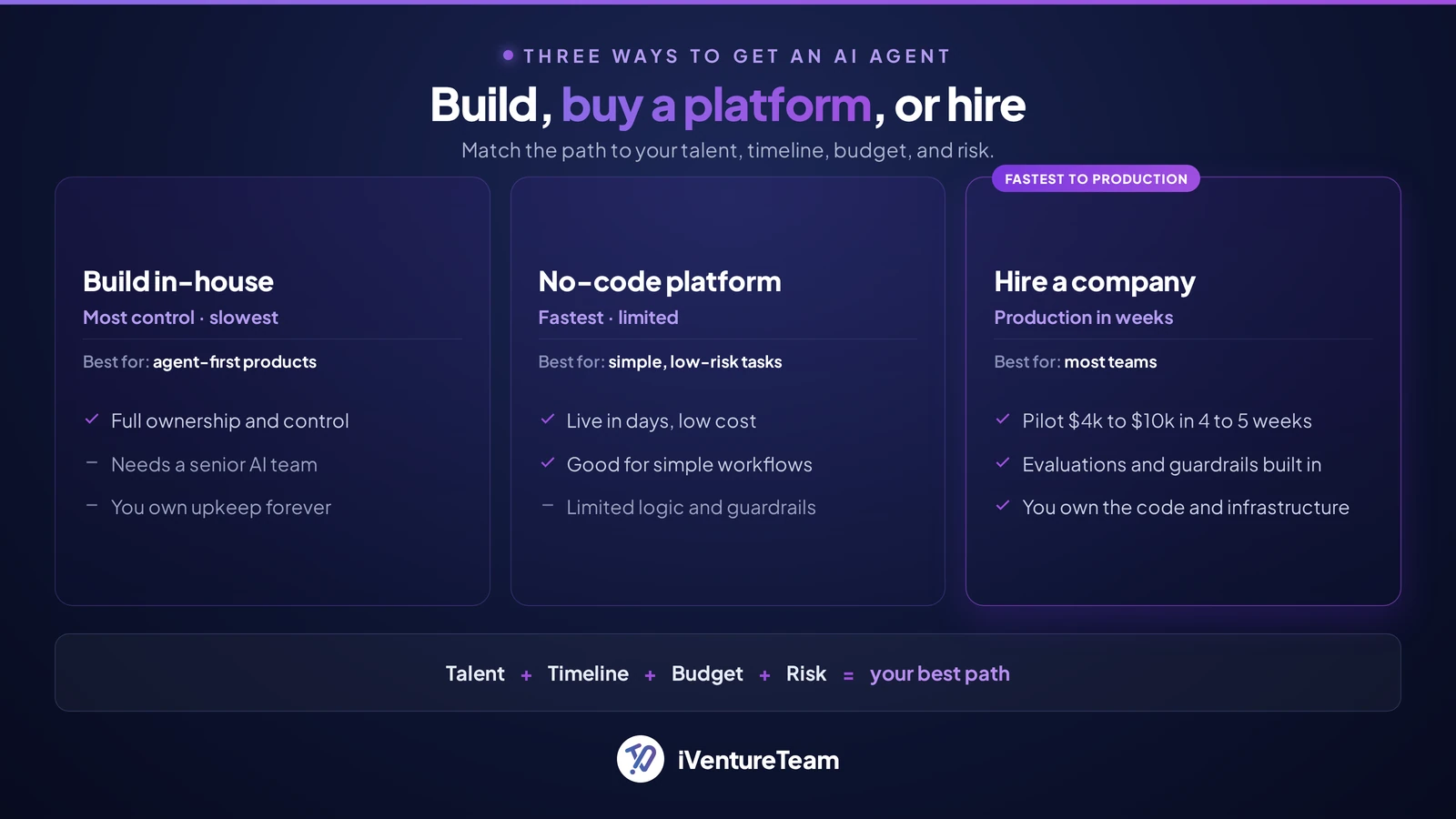
You have three ways to get an AI agent: build it in-house, assemble it on a no-code platform, or hire an AI agent development agency, with a hybrid co-build sitting between the last two.
Build in-house: maximum control and ownership, but you carry hiring, build, and lifelong maintenance. Best when agents are core to your product and you have senior AI talent.
No-code / low-code platform: tools like n8n, Make, or Copilot Studio wire simple agent workflows without deep engineering. Best for low-risk, well-defined tasks; it hits limits on custom logic, complex RAG, and guardrails.
Hire an AI agent development company: a partner designs, builds, and hardens the agent, then hands it over. Fastest route to production reliability without staffing an AI team.
Hybrid co-build: an AI Agent development partner builds the first production agent with your engineers, then transfers ownership so your team can extend it. Best when you want the capability in-house eventually but not the slow, risky first build.
What team and skills do you need to build an AI agent in-house?
Building a production AI agent in-house takes more than one generalist developer; you need AI engineering, data, MLOps, and security skills working together. If you cannot staff most of these, building from scratch will stall.
AI/LLM engineer: agent design, prompt and tool engineering, framework choice.
Data / RAG engineer: vector databases, chunking, retrieval quality, re-ranking.
Evaluation focus: an eval harness and regression testing so quality is measured, not guessed.
MLOps and infrastructure: deployment, scaling, cost control, and model routing.
Security / compliance: guardrails, PII handling, and audit for regulated data.
Be honest about which of these you have today. The gap between them is exactly what an AI agent development partner or a hybrid co-build fills.
How much does it cost to build an AI agent in-house?
The real cost of building an AI agent in-house is not the first build, it is employing and retaining the AI team that keeps it alive. Salaries and maintenance, not the prototype, dominate the number.
A senior AI engineer in the US typically carries a loaded cost well into six figures per year, and a real agent usually needs more than one skill set. Add cloud, model, and vector-database bills, plus the months of ramp before anything reaches production.
Then add the part teams forget: ongoing upkeep. Models get deprecated, prompts drift, and evals and guardrails need constant attention. In-house is the right call when agents are core to your business, but it is an ongoing commitment, not a project with an end date.
What does it cost to hire an AI agent development company?
Hiring an AI agent development company turns an open-ended commitment into a bounded, faster project with a predictable price. You buy production quality and speed instead of headcount.
Based on our own published AI agent development ranges, a single-agent production pilot runs about $4,000 to $10,000 and goes live in 4 to 5 weeks. A multi-agent system with planner, executor, and critic runs about $10,000 to $36,000 over 6 to 10 weeks.
After launch, most teams keep a light managed retainer for model upgrades, evals, and new capabilities. Running cost per task is usually cents, and a good AI agent development partner will cost-engineer an agent to be far cheaper without losing accuracy.
Hiring also gives you experienced AI agent developers without a full-time payroll. Whether you hire an AI agent development company in the USA, in India, or offshore, you are buying delivery and maintenance, not headcount.
Build or hire an AI agent development partner: a decision scorecard
Score your situation on six factors; if most point one way, that is your path. This is the decision competitors' vendor lists skip.
Factor | Lean build in-house | Lean no-code platform | Lean hire a company |
|---|---|---|---|
Agent importance | Core to your product | Internal convenience | Important but not your core IP |
In-house AI talent | Senior AI team on staff | Non-technical team | Little to no AI engineering |
Timeline | Months are acceptable | Need it this week | Need production in weeks |
Budget shape | Can fund a standing team | Minimal | Bounded project budget |
Data sensitivity / complexity | High, needs custom control | Low, standard data | High, but you want it handled |
Maintenance appetite | Willing to own upkeep forever | Minimal upkeep | Prefer a retainer to maintain |
If you scored mostly the middle column, start on a platform and revisit later. Mostly right column, hire or co-build. Mostly left, build, but staff it fully.
Build or hire an AI Agent development company: a one-year AI agent cost comparison
Over the first year, building in-house means paying a standing AI team, while hiring means a bounded project plus an optional retainer. Here is the shape of each, so the trade is clear.
Item | Build in-house | Hire a company |
|---|---|---|
Up-front team | 1 to 3 AI/data/MLOps hires (approx. market salaries, six figures each) | None |
Build cost | Absorbed in salaries over 3 to 6 months of ramp | ~$4,000 to $36,000 by scope |
Time to production | Often 3 to 6 months plus hiring | 4 to 10 weeks |
Ongoing | Full salaries and infrastructure, every year | Optional retainer + per-task cost |
You own the code | Yes | Yes, if the contract says so |
Salary figures are illustrative US market ranges, not a quote. The pattern holds regardless: in-house is a team you keep; hiring is a project you scope.
Why do in-house AI agent builds fail in production?
Most in-house agent projects do not fail at the demo; they stall on the way to production, on evaluation, hallucination, cost, and maintenance. Knowing the failure modes up front is how you avoid them.
The common ones we see: no eval harness, so quality is a guess and every prompt change is a risk; hallucination and bad tool calls with no guardrails; runaway token cost with no routing; and no owner for upkeep once the launch team moves on.
A demo needs none of these. Production needs all of them, which is the real reason build-vs-hire so often tips toward hire.
Who owns the code, and is your data secure?
If you hire, insist on owning the code, prompts, and infrastructure, and confirm how your private data is handled; a good AI agent development partner leaves you independent, not locked in. Ownership and security are where hiring goes right or wrong.
Make sure the source lives in your repository, infrastructure runs in your cloud, and prompts and evals are yours. For sensitive data, confirm permission-aware retrieval, PII redaction, and on-premise or self-hosted models where regulation needs it. Then agree who maintains the agent.
When do you not need an AI agent?
Sometimes the honest answer is that you do not need an agent at all; a chatbot or a plain automation will do the job for less. Do not over-engineer.
If the task is "answer a question from a document," a retrieval chatbot is enough. If it is "when X happens, do Y," a tool like AI workflow automation is simpler and cheaper. Reach for an agent only when the work needs planning, tool use, and multiple steps a fixed script cannot handle.
If you hire: how to choose an AI agent development company
Choose an AI agent development company on evaluation discipline, production guardrails, and whether you own the result, not on framework buzzwords. The right partner ships agents that survive real users.
Ask how they measure quality (an eval harness, not vibes), how they handle hallucination and high-risk actions, and what observability they deploy. Confirm you own the code and data.
Watch for red flags: no evals, no code ownership, no guardrails, no maintenance plan. For a deeper checklist, see our guide on how to choose an AI development company.
How iVentureTeam helps with AI agent development
iVentureTeam builds production AI agents and hands you full ownership, so you get the capability without the staffing risk. We are framework-agnostic across LangChain, LangGraph, CrewAI, and AutoGen, and eval-driven from day one.
Our AI agent development services cover tool-using agents, multi-agent systems, RAG, memory, guardrails, and observability, with source in your repository and infrastructure in your cloud. Want it in-house eventually? We co-build and hand it over. See the full AI services range.
AI agent in practice: triaging 1,800 support tickets a week
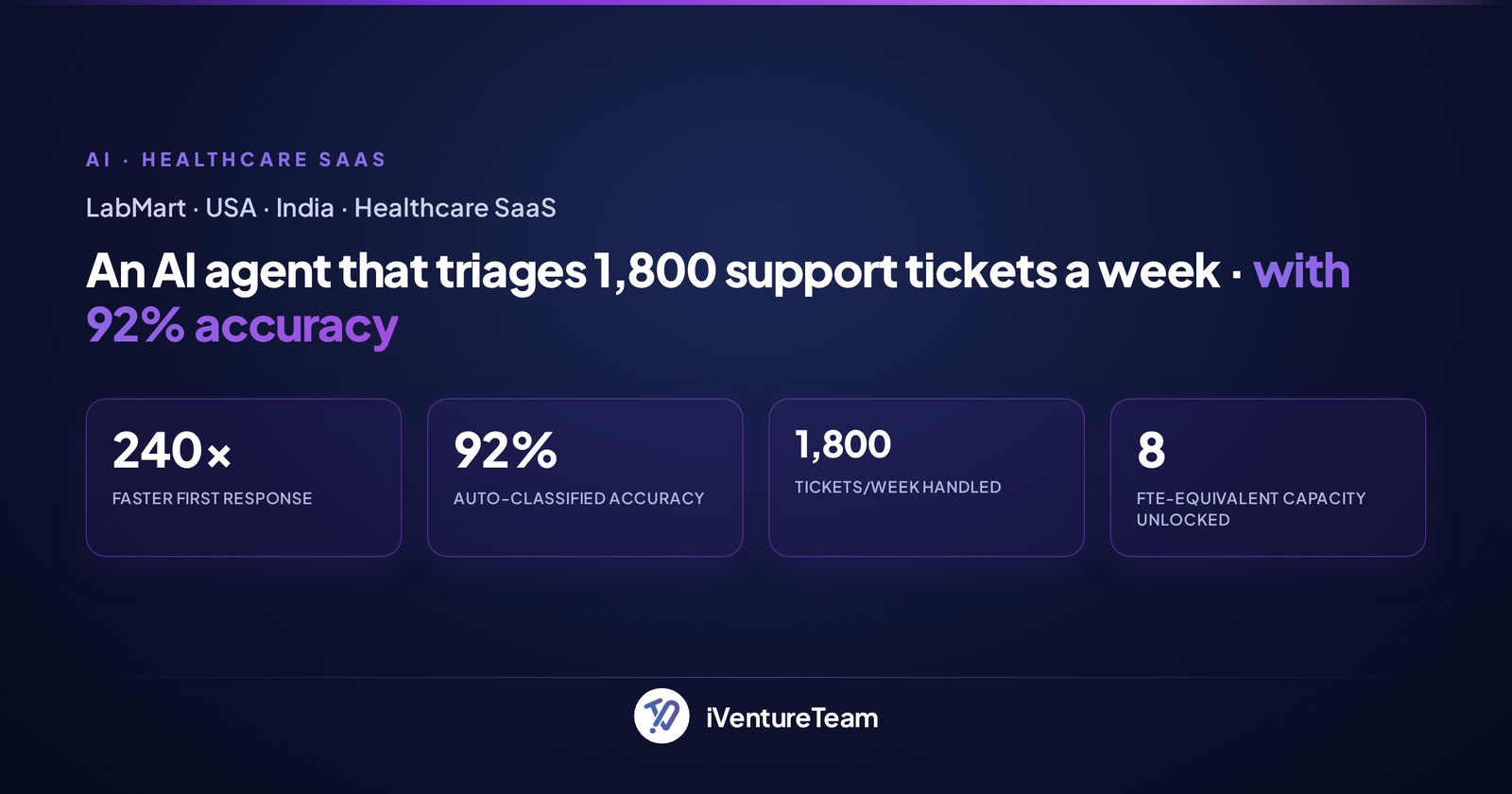
The test of an agent is whether it holds up under real volume, not in a demo. In one project, we replaced an eight-person support triage queue with an LLM-powered agent that triages 1,800 tickets a week wired into Zoho Desk and Odoo.
It reached 92 percent auto-classification accuracy and cut first response time by 240 times, unlocking eight FTEs of capacity. That is what production readiness looks like: evaluated, guard railed, and measured, not just a working prototype.
The bottom line: build, buy, or hire
Build in-house if AI agents are core to your product and you can staff and maintain a team; hire a company if you need production reliability fast; use a no-code platform for simple, low-risk workflows.
The decision is not really "build or buy," it is "who owns the hard parts": evaluation, guardrails, cost, and maintenance. Score your talent, timeline, budget, and risk honestly and the path is clear. If it points to hiring or a co-build, choose an AI Agent development partner who leaves you owning the result.
Ready to build your AI agent the right way?
You do not need to guess whether to build or hire. In one free 30-minute architecture audit, a senior engineer will scope your agent, recommend build, platform, or hire honestly, and send a fixed-price proposal within 48 hours.
Book your free AI agent audit, call +91-90235-15208, or email business@iventureteam.com.
Frequently Asked Questions about AI Agent Development
What is AI agent development?
+
AI agent development is building software that uses a large language model to take actions, not just answer questions. An agent plans steps, calls tools and APIs, retrieves data, remembers context, and completes a task end to end, with guardrails and monitoring for production use.
Should I build an AI agent in-house or hire a company?
+
Build in-house if agents are core to your product and you employ senior AI engineers who can maintain them. Hire a company if you need production reliability quickly without staffing an AI team. Use a no-code platform for simple, low-risk workflows.
How much does it cost to build an AI agent?
+
Hiring a company, a single-agent production pilot runs about $4,000 to $10,000 and a multi-agent system about $10,000 to $36,000. Building in-house means employing an AI team year-round, so salaries and maintenance, not the first build, dominate the cost.
How long does it take to build a production AI agent?
+
With a partner, a single agent with RAG, tools, and observability goes live in about 4 to 5 weeks, and a multi-agent system in 6 to 10 weeks. Building in-house usually takes longer once hiring and ramp-up are counted.
What is the difference between an AI agent and a chatbot?
+
A chatbot answers questions. An agent takes actions: it calls APIs, queries databases, executes multi-step workflows, and keeps memory across the task. Choose an agent when the job is to do something, not just to reply.
What skills do I need to build an AI agent in-house?
+
You need AI/LLM engineering, data and RAG skills, evaluation discipline, MLOps for deployment and cost, and security for guardrails and sensitive data. One generalist developer is rarely enough for a production agent.
Can I build an AI agent with no-code tools?
+
Yes, for simple, well-defined workflows, platforms like n8n, Make, or Copilot Studio work well. They hit limits on custom logic, complex retrieval, strong guardrails, and observability, which is where custom development or a partner becomes necessary.
Who owns the code if I hire an AI agent development company?
+
You should. A good AI Agent development partner keeps a source in your repository, infrastructure in your cloud, and prompts and evals in your account, so you are never locked in. Confirm ownership in the contract before you start.
Ready to put this into action?
Talk to iVentureTeam about Odoo, AI automation, or custom development — get a free, no-obligation consultation.
Free Odoo tools
All tools- Odoo Health CheckVersion, modules, findings and upgrade cost
- Odoo App SelectorWhich apps you need, by industry
- Odoo Project EstimateIndicative cost and timeline in minutes
- Odoo Implementation Cost CalculatorImplementation cost and timeline, in minutes
- Odoo Migration Cost CalculatorVersion jump or legacy ERP, priced in minutes
Continue reading

Odoo 20 MCP Server: Connect Claude or ChatGPT to Odoo Safely
Odoo 20 MCP server guide: versions and plans, OAuth and API key setup for Claude and ChatGPT, default tools, access rights, approvals and community servers.

How to Compare Odoo Implementation Proposals: Checklist and Scorecard
How to compare Odoo implementation proposals: a line-item checklist, scope exclusions to price, quote red flags, real cost ranges and a weighted scorecard.

Odoo 20 Upgrade and eCommerce Integrations: Order Flow Risk
Odoo 20 upgrade risks for eCommerce integrations: Shopify, Amazon and WooCommerce connectors, payments, shipping, SKU mapping, cutover and reconciliation.