How to Choose the Right AI Chatbot Development Company: 8-Point Founder's Checklist
 Siddharth JambukiyaOdoo Techno-Functional Consultant



Every founder evaluating an AI chatbot development agency has seen the same thing: the demo looks flawless. The hard part is what happens after go-live, when the bot meets real customers, messy data, and your existing systems.
Adoption is not the question anymore, as 78% of organizations now use AI in at least one business function, up from 55% a year earlier, according to Stanford's 2025 AI Index Report. The question is who can build one that holds up in production.
This guide is a practical 2026 checklist for choosing that partner, especially if a past vendor over-promised and under-delivered.
What an AI chatbot development company actually does
An AI chatbot development company designs, builds, and integrates conversational AI systems that understand natural language and act on your business data. The good ones do far more than wire up a chat window.
A capable partner works across three layers.
First, the language layer: natural language understanding (NLU) that reads intent, and a large language model (LLM) that generates the reply.
Second, the knowledge layer: retrieval-augmented generation (RAG), which grounds answers in your documents and live records so the bot cites facts instead of inventing them.
Third, the action layer: integrations that let the bot read and write to your ERP, CRM, or helpdesk, so it resolves the request, not just describes it.
The difference between a demo and a deployment lives in those last two layers. Anyone can show a chatbot answering a scripted question. Grounding it in your data and connecting it to your systems is the real work, and the real reason to hire a specialist rather than buy a template.
Which type of AI chatbot do you actually need?
Before you shortlist AI chatbot development companies, get clear on the type of bot your use case calls for, because it changes who you hire and what you pay for. The main types of AI chatbots fall into three groups.
Rule-based bots: best for simple, fixed flows like FAQs, order status, or lead capture, where the answers rarely change.
Retrieval (RAG) bots: best when the bot must answer from your own documents and data with source citations, such as support or internal knowledge.
Agentic bots: best when the bot has to take action across systems, like updating a ticket, checking stock, or processing a request, not just reply.
Most production deployments blend retrieval and action. If a company pushes one type for every problem, treat that as a red flag, not a recommendation.
The 2026 checklist: 8 things to check in an AI chatbot development company
Judge every company against these eight points. Score each one from 1 (weak) to 3 (strong). Treat the four marked Dealbreaker as pass or fail: if a partner is weak on any of them, walk away, however good the rest looks. Total the others to compare your finalists.
1. Real production experience, not demos (Dealbreaker)
Ask for live metrics from a chatbot they run today: intent-recognition accuracy, session volumes, containment rate, and model-drift logs over time. A partner who can only show a sandbox is still learning on your budget. Post-deployment dashboards are the clearest proof that their work survives contact with real users.
2. Model-agnostic, not locked to one provider (Weighted)
A strong partner chooses the model that fits your use case, whether that is a GPT, Gemini, Claude, or an open-weight model, and can switch as costs and capabilities change. If every project they show runs on one vendor's model, you are buying their preference, not your best option.
3. Grounding on your data with RAG (Dealbreaker)
Confirm the bot answers from your knowledge base through retrieval-augmented generation, with source citations. Grounding is what stops a chatbot from producing a confident, wrong answer, and the risk is real: independent 2025 benchmarks put LLM hallucination rates anywhere from roughly 5% to over 50%, depending on the model and task. Ask how they handle questions the bot should refuse, and how they keep the knowledge base current.
4. Integration with your existing systems (Dealbreaker)
A chatbot that cannot reach your ERP, CRM, or helpdesk can only talk, not resolve. Check that the company has built real integrations, not just embedded widgets, and can work across the platforms you already run. This is where many generic AI chatbot development services stop, and where the actual value begins.
5. Security, privacy, and compliance (Weighted, and a Dealbreaker if you are regulated)
The partner should be able to explain data handling, access controls, and how they meet the regulations you answer to, before you ask twice. For customer-facing or regulated workflows, this is not optional. Weak answers here are a reason to walk.
6. Customization over templates (Weighted)
Your business is not a template, and a reskinned generic bot will show it. Confirm they tailor the flows, tone, and logic to how your team actually works, rather than fitting you into a fixed product. Ask to see a build that clearly could not have come off a shelf.
7. Post-launch support, ownership, and handover (Dealbreaker)
A chatbot is not finished at launch; it needs tuning as language, data, and needs change. Confirm what support looks like, and confirm you own the code, prompts, and data at handover. If the arrangement quietly locks you in, that is a cost, not a convenience.
8. Transparent pricing and realistic timelines (Weighted)
A credible partner explains what drives cost and gives a timeline they can defend, instead of a suspiciously round number and a rushed date. Fixed-scope and time-and-materials models both work; vague pricing with no breakdown does not.
How much does AI chatbot development cost?
AI chatbot development usually costs between about $3,000 and $100,000+, depending on complexity, and published price guides across the industry cluster into three tiers.
Use the tiers below as a planning range, then get a scoped quote. The band you land in is set far more by integrations and data work than by the language model itself.
Chatbot type | Typical cost | Best for |
Simple rule-based bot | $3,000 to $15,000 | FAQs, lead capture, appointment booking |
Custom AI chatbot (RAG + integrations) | $20,000 to $80,000 | Grounded answers, automation, connected to your systems |
Enterprise conversational AI | $100,000 and up | Multi-system workflows, complex integration, governance |
Four factors move the price most: the number and depth of integrations (CRM, ERP, helpdesk), how much data preparation your knowledge base needs, the complexity of the natural language understanding, and ongoing tuning after launch. Ranges are indicative and vary by region and scope, so confirm against a real quote for your use case.
How to evaluate an offshore or global partner
Many of the strongest AI chatbot teams are offshore or global, and that can be an advantage if you screen for the right things. The keyword is not location, it is how they run a remote engagement.
Check three things beyond the eight above.
Communication: fixed overlap hours, a named point of contact, and a regular demo cadence, so you are never guessing about status.
Intellectual property: a written agreement that you own the code, models, and data, with no ambiguity.
Delivery track record: references from clients in your region or industry who can speak to working across time zones.
A global chatbot development partner who handles these well often gives you deeper expertise for the budget than a purely local shop.
Green flags vs red flags
The fastest way to read a vendor is to watch which way they lean when you ask a hard question. Here is the pattern.
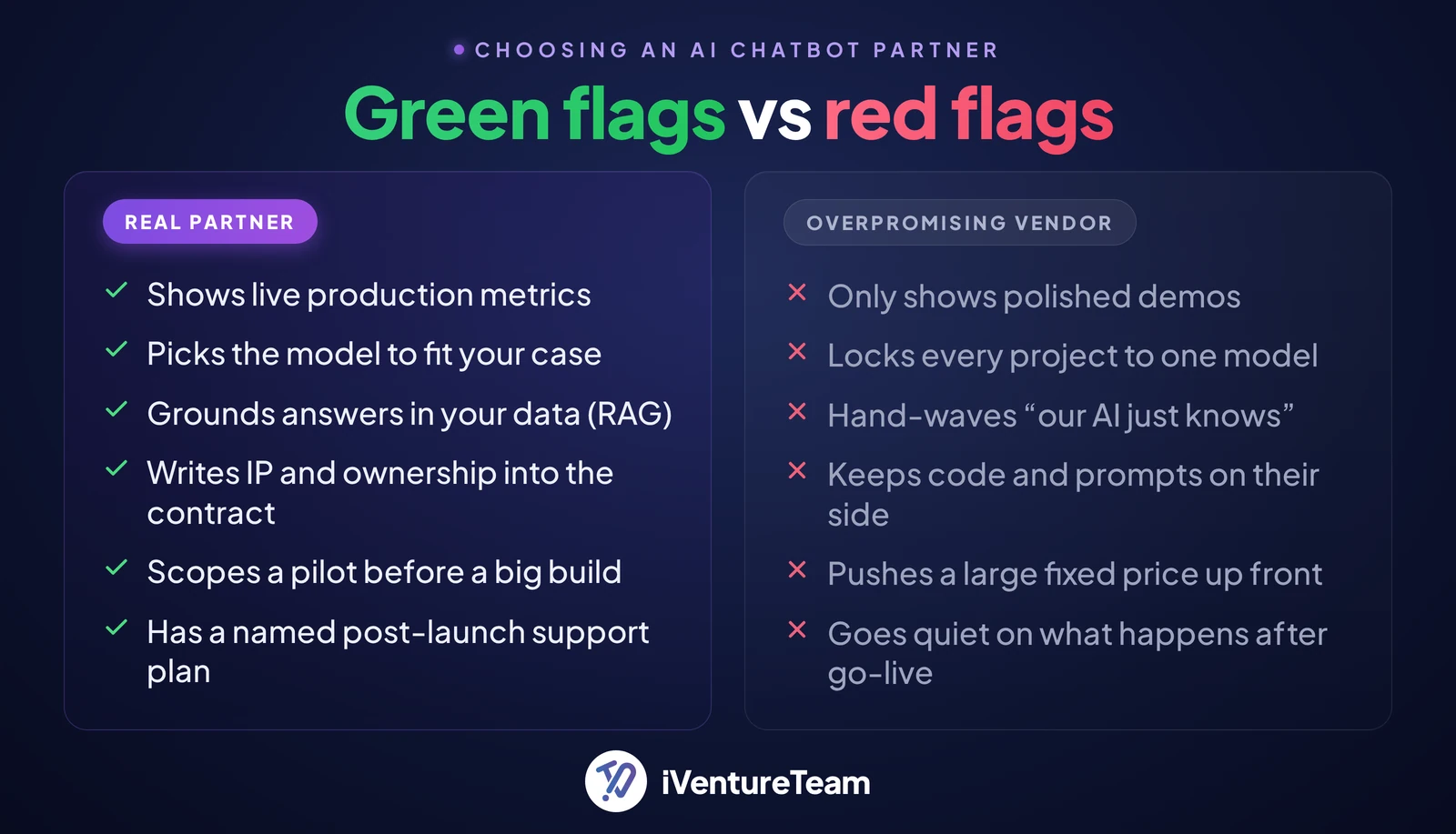
If a company sits in the right column for even two or three rows, treat it as a warning, not a detail. Those are the exact gaps that surface after the invoice clears.
Questions to ask before you sign
Use these in the evaluation call. The quality of the answers tells you more than any brochure.
Can you show live metrics from a chatbot you run today, including accuracy and volume?
How do you ground answers in our data, and how do you prevent hallucinations?
Which models have you deployed, and how do you decide which to use?
What integrations have you built with systems like ours (ERP, CRM, helpdesk)?
How do you handle security, access, and the regulations we operate under?
What does support look like after launch, and what exactly do we own at handover?
What would a small pilot look like before we commit to the full build?
Should you build an AI chatbot in-house or hire a company?
Building an AI chatbot in-house makes sense if you already have experienced AI, machine learning, and integration engineers with the time to develop, deploy, and maintain it. For most businesses, however, partnering with an experienced AI chatbot development company is typically the faster and more cost-effective way to launch a production-ready solution.
The biggest challenge is rarely the AI model itself. It is integrating the chatbot with your existing systems, securing business data, and maintaining reliable performance over time. An experienced AI development partner can help you evaluate your requirements and recommend the approach that best fits your goals, budget, and timeline.
How iVentureTeam approaches AI chatbot development
We build AI chatbots designed for production environments, integrating them with your existing business systems, data, and workflows. Every project starts by identifying the one or two high-impact use cases where AI can deliver the greatest business value.
We then connect the chatbot to your ERP, CRM, knowledge base, or other business applications so it fits into your day-to-day operations. With 13+ years of technology consulting experience and 500+ successfully delivered projects for clients across 35+ countries, we specialize in building AI solutions that integrate reliably with complex business environments.
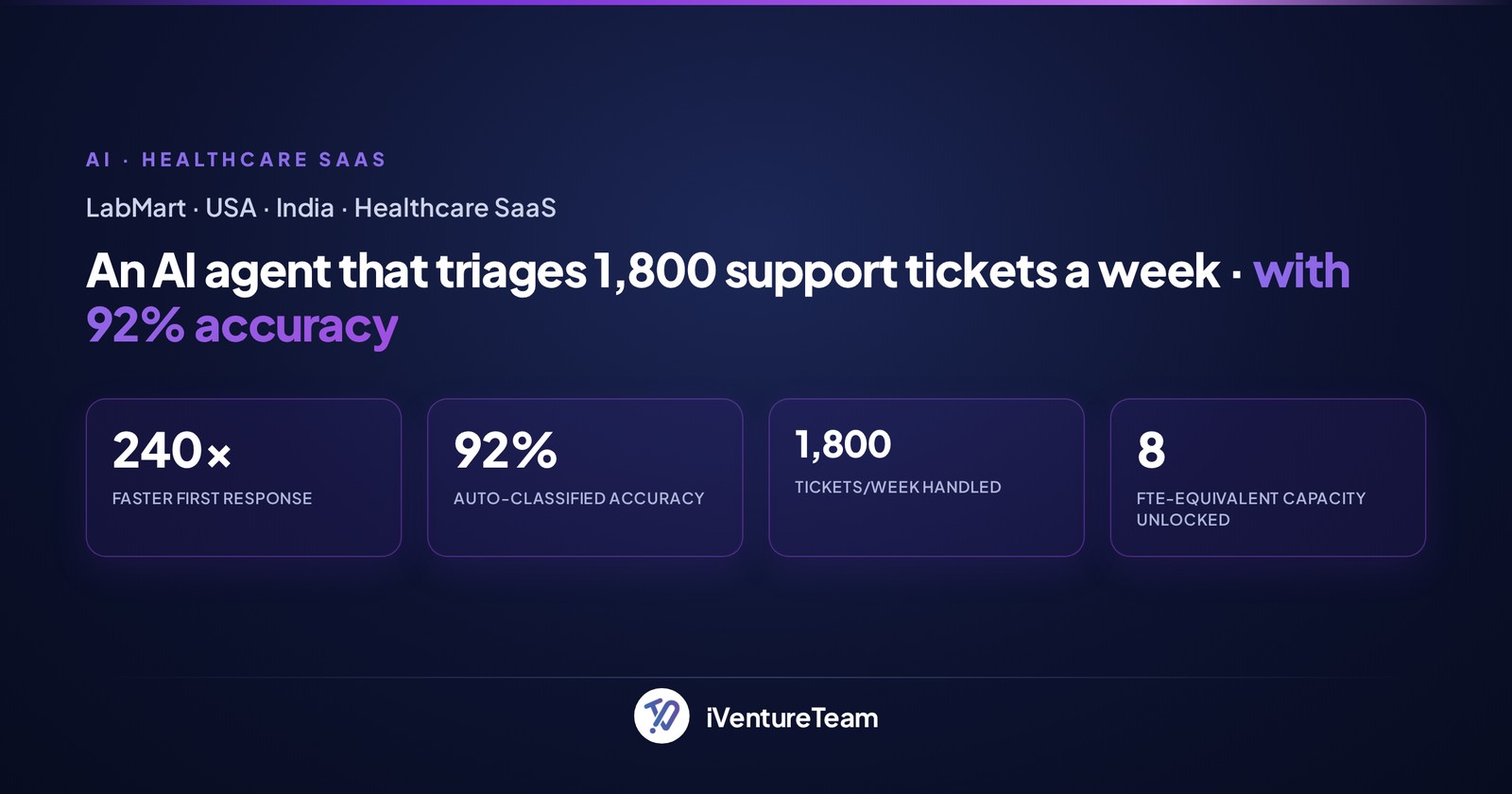
For a lab supplies retailer, we built an AI agent that triages roughly 1,800 support tickets a week, routing and drafting responses so the team clears the queue faster. It reflects how we prefer to work: a narrow, high-volume task where the bot removes hours of manual effort, with the integration and guardrails to make it safe. You can see how our AI chatbot development and AI-Odoo integration services fit together across the wider stack.
Conclusion
The demos will always look good. The partner worth hiring is the one who can prove production performance, ground answers in your data, integrate with your systems, and hand you real ownership at the end.
Screen on proof, grounding, and fit, score the eight points, and keep the red-flag column close. Choose that way and an AI chatbot becomes a workflow you trust, not a project you have to rescue.
Ready to choose with confidence?
You do not need a long RFP to start. In one free scoping call, we will map your best first chatbot use case, the data it needs, the systems it must connect to, and whether a pilot or a full build fits better.
You walk away with a clear, costed plan for a chatbot that works in production, not a slide deck.
Book a free AI chatbot scoping call with our team.
FAQs About Choosing an AI Chatbot Development Company
How much does AI chatbot development cost?
+
Most AI chatbot development projects fall into three cost tiers: a simple rule-based bot (FAQs, lead capture) typically runs about $3,000 to $15,000; a custom AI chatbot with RAG and integrations about $20,000 to $80,000; and enterprise conversational AI with multi-system integration and governance $100,000 and up.
These are indicative industry ranges, so treat any single number with caution. Integrations and data preparation drive cost more than the model itself, and a credible company will break this down for your scope rather than quote a flat figure blind.
How long does it take to build an AI chatbot?
+
A focused, single-workflow chatbot can go live in a few weeks; a deeply integrated, multi-system deployment takes longer. The timeline is driven mostly by integration complexity and data readiness. Be wary of anyone promising a full production rollout in days.
Should I hire an agency or build in-house?
+
Hire a chatbot development specialist if you lack in-house machine-learning and integration engineers, which is most teams. In-house makes sense when you have the talent and expect continuous, long-term development. Many companies start with a chatbot development partner and bring maintenance in-house later.
What actually makes a chatbot "AI" rather than a rule-based bot?
+
An AI chatbot uses natural language understanding and a language model to interpret intent and generate responses, instead of following fixed decision trees. The meaningful upgrade is grounding through RAG, which lets it answer from your real data rather than scripted replies.
How do I know the chatbot won't hallucinate?
+
Ask how the company grounds answers in your data, cites sources, and defines the topics the bot should refuse. Retrieval-augmented generation plus clear guardrails is what keeps a chatbot from producing confident, wrong answers. A partner who cannot explain this is a risk.
What should I own when the project is handed over?
+
You should own the source code, the prompts, the configuration, and your data, in writing. If a vendor keeps any of these, you are locked in. Confirm ownership terms before you sign, not at the end.
Ready to put this into action?
Talk to iVentureTeam about Odoo, AI automation, or custom development — get a free, no-obligation consultation.
Continue reading

Odoo Upgrade Verification: Problems That Do Not Surface Until Month-End

Odoo 20 Field Service Change: Impact on Dispatch and Service Operations
