
Odoo in the Middle East: Does It Handle UAE VAT, FTA E-Invoicing, and GCC Compliance?
 Siddharth JambukiyaOdoo Techno-Functional Consultant




Middle East businesses do not just need an ERP, they need one that keeps them on the right side of the FTA and ZATCA. Whether you run in Dubai, Abu Dhabi, or Riyadh, this guide covers what Odoo genuinely handles for the region, what needs configuration, and how to get compliant.
Want your UAE, Dubai, or Saudi Odoo setup done right? Our Odoo implementation services cover the localization and tax setup. For rollout cost and time, see our Odoo implementation methodology guide.
Does Odoo handle UAE VAT?
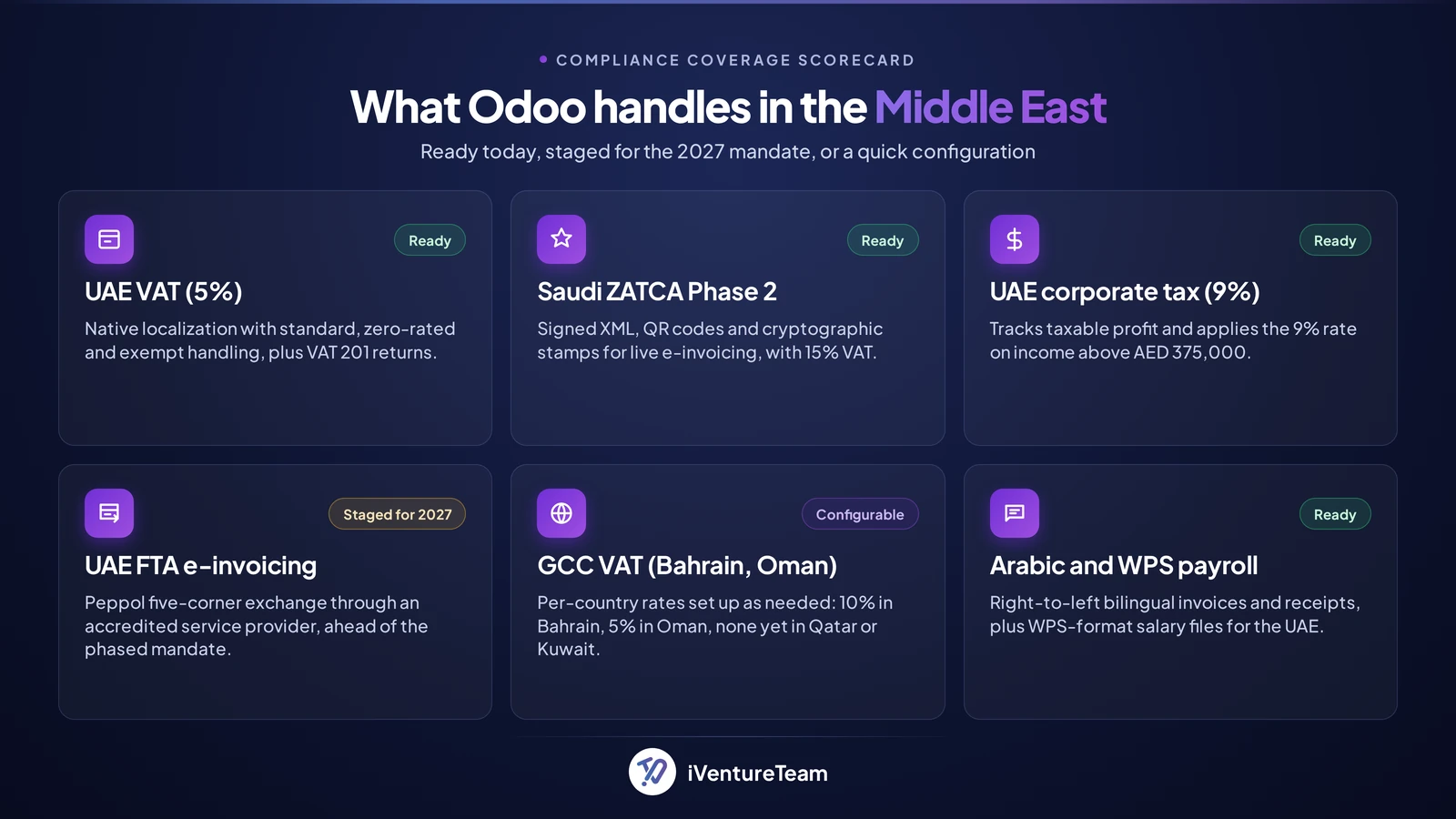
Yes, Odoo handles UAE VAT natively: its UAE localization ships with the 5% standard rate, zero-rated and exempt handling, TRN fields, reverse charge, and the VAT 201 return. For most UAE businesses, VAT is the part of compliance that works out of the box.
Odoo applies the correct tax on sales and purchases, tracks input and output VAT, and produces the VAT 201 figures the Federal Tax Authority expects. It also handles designated-zone and reverse-charge scenarios that trip up simpler tools.
What still needs a human is the setup: the right chart of accounts, tax mapping per product and customer, and your TRN on invoices. Get the configuration right and VAT filing becomes a report, not a monthly scramble.
VAT is the settled part of UAE compliance. The faster-moving obligation, and the one most buyers ask about next, is e-invoicing.
Is Odoo ready for UAE FTA e-invoicing?
Odoo is getting ready for UAE FTA e-invoicing through localization updates and an accredited service provider. The mandate is voluntary from July 2026 and compulsory in stages from January 2027.
Because the UAE routes invoices through accredited providers, Odoo connects to one rather than being accredited itself.
The UAE uses the Peppol five-corner model with the PINT AE format, set out in Ministerial Decisions 243 and 244 of 2025. Odoo produces the structured invoice; an accredited service provider exchanges it and reports the tax data to the FTA in near real time.
Practically, that means UAE FTA e-invoicing readiness in Odoo depends on running a current, localized version and connecting an accredited provider before your deadline. Plan the provider selection early, because the first mandatory wave is close.
The UAE e-invoicing timeline: key dates to plan around
Date | What happens |
|---|---|
1 July 2026 | Voluntary e-invoicing and pilot begin, open to all businesses |
1 January 2027 | Mandatory for businesses with revenue of AED 50 million or more |
1 July 2027 | Mandatory for businesses with revenue under AED 50 million |
1 October 2027 | Mandatory for government entities |
Dates are based on the UAE Ministry of Finance and Federal Tax Authority announcements and can be refined, so confirm your wave and appoint a service provider well ahead of it.
The UAE is still phasing e-invoicing in. Saudi Arabia, by contrast, is already live, which is where compliance gets real today.
Does Odoo support Saudi ZATCA e-invoicing (Fatoora)?
Yes, Odoo supports Saudi ZATCA e-invoicing. Its Saudi localization generates the signed XML, QR codes, and cryptographic stamps that ZATCA Phase 2 requires, with the 15% VAT rate.
For Saudi Arabia, e-invoicing is already live, so this is a problem today, not a future one.
Odoo produces ZATCA-compliant invoices for both scenarios: clearance for B2B invoices, which are cleared with ZATCA before sharing, and reporting for B2C invoices, which are reported after issue. It handles the QR code, the invoice hash, and the XML structure ZATCA mandates.
As with the UAE, the software capability is only half the job. ZATCA onboarding, the cryptographic certificate (CSID), and correct tax configuration have to be done for each business before your invoices actually clear.
E-invoicing covers how you bill. The other newer UAE obligation is what you owe on profit: corporate tax.
Does Odoo handle UAE corporate tax?
Yes, Odoo handles UAE corporate tax: you can track taxable profit, apply the 9% rate on profits above AED 375,000, and produce the financial reports a corporate tax return needs. Corporate tax is newer than VAT, so many businesses ask about it specifically.
Odoo's accounting gives you the profit-and-loss detail, analytic accounting, and audit-ready records that corporate tax filing relies on. It does not replace a tax advisor, but it gives your accountant clean, structured numbers instead of spreadsheets.
The setup that matters here is your chart of accounts and reporting structure, so taxable income, exempt income, and adjustments are separable when the return is due.
That covers the UAE and Saudi Arabia. If your group trades more widely, the rest of the GCC brings its own rates and rules.
What about VAT across the rest of the GCC?
Odoo covers VAT across the GCC, with native localizations and the correct rate for each country, so a group operating in several markets runs on one system. VAT is not uniform across the Gulf, and Odoo's multi-company setup is built for that.
United Arab Emirates: 5% VAT, FTA e-invoicing arriving 2026 to 2027.
Saudi Arabia: 15% VAT, ZATCA Phase 2 e-invoicing live now.
Bahrain: 10% VAT.
Oman: 5% VAT.
Qatar and Kuwait: VAT announced but not yet implemented at the time of writing.
With Odoo's multi-company and multi-currency support, a group can run UAE, Saudi, and other entities in one database, each with its own tax rules, and still consolidate reporting.
Rates and returns are only part of running here. The day-to-day regional essentials matter just as much.
What Middle East features does Odoo include beyond tax?
Beyond tax, Odoo includes the regional essentials Gulf businesses need: full Arabic right-to-left interface and invoices, multi-currency, multi-company, and payroll that supports WPS salary files.
Compliance is more than VAT, and this is where a global ERP either fits the region or fights it.
Odoo runs bilingual Arabic and English documents, so invoices and receipts read correctly for customers and auditors. Its payroll can produce the Wage Protection System files UAE and Saudi employers must submit, and its point of sale handles Arabic receipts with taxable and non-taxable lines.
These are the details that make Odoo feel local rather than imported, and they matter as much to daily operations as the tax engine does.
So the capability is broad. The real risk is not what Odoo can do, but what gets missed during setup.
Where Odoo compliance gaps hide
The gap in Middle East compliance is rarely the software, it is the setup: your Odoo edition, version, e-invoicing provider, Arabic templates, and data residency decide whether you are actually compliant.
A default Odoo is not a compliant Odoo.
Edition: the full localization, e-invoicing, and studio tools generally need Odoo Enterprise, not Community, so budget for the license.
Version: ZATCA and FTA e-invoicing support depends on a recent Odoo version, so old deployments usually need an upgrade first.
Accredited provider: UAE e-invoicing requires connecting an accredited service provider, and ZATCA requires onboarding and a certificate per company.
Arabic and templates: invoice and receipt layouts must be configured in Arabic and English with the right legal fields.
Data residency: regulated and government entities may need in-region hosting, which means Odoo.sh region choice or on-premise rather than default cloud.
Close these gaps at implementation and compliance is routine. Skip them and you have software that could be compliant but is not.
Closing those gaps at Odoo implementation is exactly the work we do.
How iVentureTeam helps with Odoo in the Middle East
iVentureTeam implements and configures Odoo for UAE and GCC compliance, so your VAT, e-invoicing, Arabic, and payroll are correct from day one, not left as a to-do list. We are an experienced Odoo ERP implementation partner that has delivered ERP projects in 35+ countries, including in the Gulf.
Our expert Odoo developers team sets up the UAE and Saudi localizations, maps your taxes and chart of accounts, connects the right e-invoicing provider, and configures Arabic templates and WPS payroll.
When you are moving off Tally, QuickBooks, or a local tool, our Odoo migration services bring your data across cleanly, and Odoo consulting scopes the compliance setup before build.
Here is what that looks like on the ground.
Odoo in practice: bilingual Arabic and English tax receipts in the Gulf
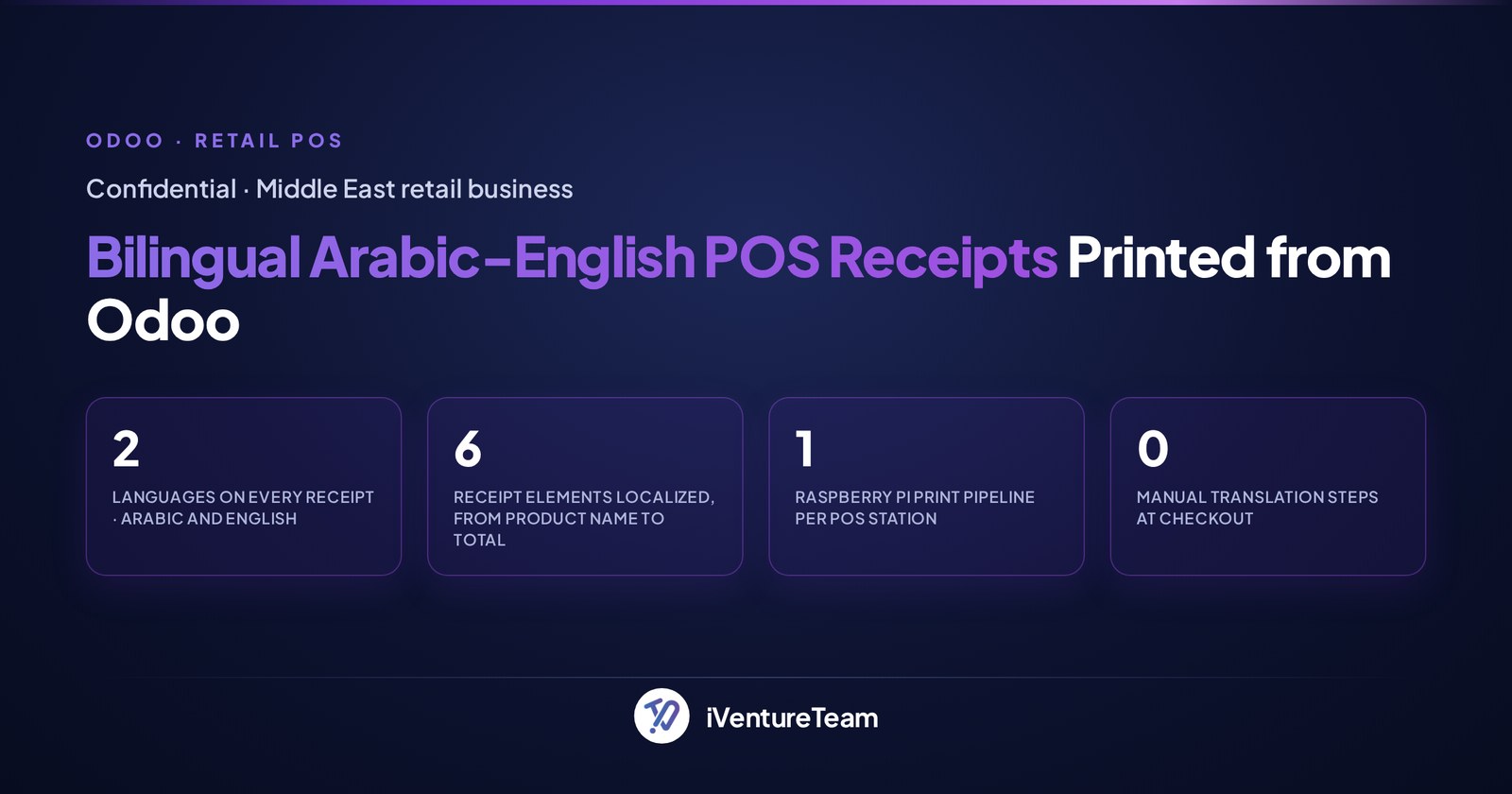
A working Middle East deployment has to read in Arabic and print tax correctly, not just in a demo. For a Gulf retailer, we customized Odoo point of sale to print bilingual Arabic and English receipts.
Each slip shows product names, taxable and non-taxable amounts, subtotal, and total on one receipt, in both languages.
That is the regional detail that decides whether Odoo works on the ground: correct Arabic layout, correct tax lines, and receipts an auditor and a customer can both read. Getting the localization right is exactly what turns "Odoo supports the region" into "Odoo runs our business here."
The bottom line: is Odoo compliant in the Middle East?
Odoo is compliant in the Middle East when it is set up for the region: it handles UAE VAT and corporate tax, Saudi ZATCA e-invoicing, and GCC VAT today, with UAE FTA e-invoicing readiness arriving for 2027. The software is capable; the configuration is what makes it compliant.
Treat the edition, version, e-invoicing provider, Arabic templates, and data residency as part of the project, not an afterthought. Do that, and Odoo gives Gulf businesses one system for VAT, e-invoicing, payroll, and operations, ready for the mandates coming into force.
Ready to get Odoo compliant in the UAE and GCC?
You do not have to guess whether your Odoo will pass an FTA or ZATCA check. In one free 30-minute consultation, a senior Odoo consultant will review your compliance needs and recommend the right edition, e-invoicing provider, and setup, then map out a clear implementation plan.
Book your free Odoo Middle East compliance call, or directly reach us on +91-90235-15208, or email business@iventureteam.com.
Frequently Asked Questions about Odoo in the Middle East
Does Odoo support UAE VAT?
+
Yes. Odoo's UAE localization includes the 5% standard rate, zero-rated and exempt handling, TRN fields, reverse charge, and VAT 201 reporting. It calculates input and output VAT and produces the figures the Federal Tax Authority expects, once your chart of accounts and tax mapping are configured.
Is Odoo ZATCA compliant in Saudi Arabia?
+
Odoo's Saudi localization supports ZATCA Phase 2 e-invoicing: it generates signed XML, QR codes, and cryptographic stamps for both B2B clearance and B2C reporting, with 15% VAT. Each company still needs ZATCA onboarding and a cryptographic certificate before invoices are clear.
Is Odoo ready for UAE FTA e-invoicing?
+
Odoo is preparing UAE FTA e-invoicing through localization updates and integration with an accredited service provider. The mandate is voluntary from July 2026 and mandatory in stages from January 2027. Odoo connects to the FTA through an accredited provider rather than being accredited itself.
When is e-invoicing mandatory in the UAE?
+
Voluntary e-invoicing starts in July 2026. It becomes mandatory for businesses with revenue of AED 50 million or more from January 2027, for businesses under that threshold from July 2027, and for government entities from October 2027. Confirm your wave with the Federal Tax Authority.
Does Odoo handle UAE corporate tax?
+
Yes. Odoo tracks taxable profit and supports the 9% corporate tax on profits above AED 375,000, and its accounting produces the profit-and-loss detail and audit-ready records a corporate tax return needs. It complements, rather than replaces, a tax advisor.
Do I need Odoo Enterprise for e-invoicing in the Middle East?
+
Generally yes. The full UAE and Saudi localizations, e-invoicing, and Studio customization typically require Odoo Enterprise, and a recent Odoo version, rather than Community. Budget for the license and, if you are on an old version, an upgrade before e-invoicing go-live.
Can Odoo handle free zone and designated zone VAT in the UAE?
+
Yes. Odoo's UAE localization handles designated zone and free zone treatment, including out-of-scope and reverse-charge scenarios, once your tax positions and customer or supplier setup are mapped. This is a configuration step, not a code change.
What are the VAT rates across the GCC in Odoo?
+
Odoo supports each country's rate: 5% in the UAE, 15% in Saudi Arabia, 10% in Bahrain, and 5% in Oman, with Qatar and Kuwait not yet implementing VAT. Multi-company setup lets a group run several GCC entities, each with its own tax rules, in one system.
Ready to put this into action?
Talk to iVentureTeam about Odoo, AI automation, or custom development — get a free, no-obligation consultation.
Free Odoo tools
All tools- Odoo Health CheckVersion, modules, findings and upgrade cost
- Odoo App SelectorWhich apps you need, by industry
- Odoo Project EstimateIndicative cost and timeline in minutes
- Odoo Implementation Cost CalculatorImplementation cost and timeline, in minutes
- Odoo Migration Cost CalculatorVersion jump or legacy ERP, priced in minutes
Continue reading

Odoo Implementation Mistakes: 10 Causes of Failure and Their Fixes
The 10 most common Odoo implementation mistakes, the warning signs, the fixes, and a pre-kickoff checklist to stop scope, data and custom code problems.

Odoo Fixed-Fee vs Time and Materials: Which Pricing Model to Choose
Odoo fixed-fee vs time and materials explained: capped T&M, milestones, Success Packs, change requests and how to choose the right implementation model.

Odoo Warehouse Management System: WMS Guide for Odoo 19 and 20
Set up the Odoo warehouse management system in Odoo 19 and 20: locations, putaway rules, routes, replenishment, barcode picking, cycle counts and 3PL limits.